
NAME OF THE ORGANIZATION, EMBLEM, MOTTO — GUIDING PRINCIPLES, PURPOSE, OPERATING PRINCIPLES, RITES — AREA OF OPERATION, HEAD OFFICE — ASSETS, FINANCES — LEGAL REPRESENTATIVE, SEAL DESIGN
CHAPTER I. NAME OF THE ORGANIZATION, EMBLEM, MOTTO
Article 1: Name of the organization
The official title of the religious organization is: MINH LY DAO TAM TONG MIEU (referred to for short as MINH LY DAO).
Article 2: Emblem
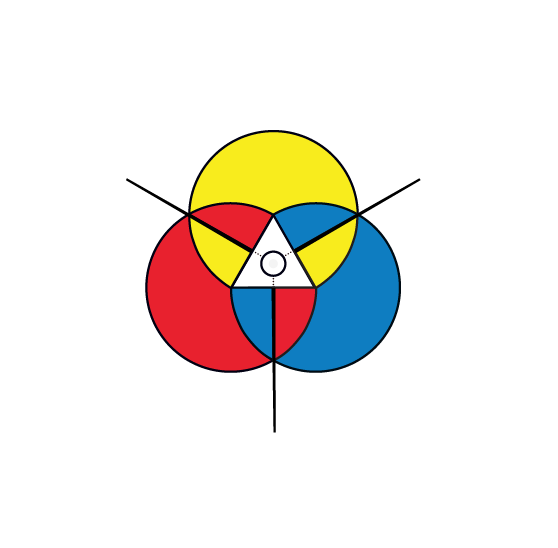
The emblem of MINH LY DAO consists of a white equilateral triangle containing a small circle with a dot at its center, symbolizing God in Three Persons (Thuong De ba ngoi). Based upon the triangle are three large circles: a large yellow circle symbolizing Buddhism; a large red circle symbolizing Confucianism; a large blue circle symbolizing Taoism. Three perfectly straight black lines radiate outward from the small central circle, symbolizing fairness, clarity, and rectitude.
Article 3: Motto
The motto of Minh Ly Dao is: Equality – Cooperation – Harmony.
CHAPTER II. GUIDING PRINCIPLES, PURPOSE, OPERATING PRINCIPLES, RITES
Article 4: Guiding principles
Minh Ly Dao bases its guiding principles on the teachings of the Three Teachings — Buddhism, Taoism, and Confucianism — from which it establishes its precepts and canon law; it harmonizes all beliefs and communal tendencies together with ancient and modern doctrines of East and West, extends compassion widely without discrimination by region, and aims to propagate the true Dharma and serve humankind on the foundation of compassion, awakening, and liberation.
Article 5: Purpose
The purpose of Minh Ly Dao is to unite the essence of the three great Eastern religions — Buddhism, Taoism, and Confucianism — in order to rediscover their common source, the Way (Dao), and from there to cultivate oneself, achieve self-liberation and the liberation of others, help relieve the suffering of humankind, and build peace and well-being for the Fatherland and for humanity.
Article 6: Operating principles
Minh Ly Dao’s operating principle is to remain purely devoted to religious cultivation, bringing the Way to save the world without allowing worldly self-interest to intrude upon religious affairs. Minh Ly Dao operates within the framework of the Constitution and laws of the Socialist Republic of Vietnam.
Article 7: Form of worship at the Tam Tong Mieu Sanctuary
On the Main Sanctuary (viewed from within, facing outward), directly at the center of the Buu Dien (Sacred Hall) stands the Heaven Altar (Thien Ban), arranged in five tiers:
- First tier: 1 tablet enshrining Dieu Tri Kim Mau (the Golden Mother of the Jasper Pool).
- Second tier: 2 tablets — on the right, Ngoc Hoang Thuong De (the Jade Emperor, Supreme God); on the left, Hong Quan Lao To (Patriarch Hong Quan).
- Third tier: 3 tablets enshrining the Patriarchs of the Three Teachings — in the center, the Buddha of the Western Paradise; on the right, Thai Thuong Lao Quan; on the left, Van Tuyen Khong Thanh (Confucius).
- Fourth tier: 4 tablets enshrining the Four Great Bodhisattvas — Dia Tang Bo Tat (Ksitigarbha), Van Thu Bo Tat (Manjushri), Pho Hien Bo Tat (Samantabhadra), Quan Am Bo Tat (Avalokitesvara).
- Fifth tier: 5 tablets enshrining the Five Great Star Lords — the Star Lords of the South, East, West, North, and Center, together with two shared tablets: the Buddhas of the Thunderous Sound (Loi Am) and the True Immortals of Bong Lai (Penglai) — symbolizing liberation and worldly bondage respectively.
All the tablets arrayed upon the Heaven Altar form a triangle, with the throne of the Buddha of the Western Paradise at its exact center, directly beneath the glass oil lamp hung in the Sacred Hall (representing the Middle Way).
In addition: to the left of the Sacred Hall stands the altar of Duc Dia Mau Tu Ton (the Venerable Earth Mother), where male worshippers attend the rites; to the right stands the altar of the Ancestors of Past Generations, where female worshippers attend the rites; on either side stand the altars of Thanh Phuoc Chanh Than (Guardian Spirit of Blessing) and the Ten Kings of the Underworld; and facing the Heaven Altar stand the altars of Long Than Ho Phap (the Dragon Spirit Protector of the Dharma, inner side) and Mon Quan Tho Dia (the Guardian Spirit of the Gate and Land, outer side).
Article 8: Form of worship at sacred shrines, sacred houses, and private homes
At sacred shrines: on the wall directly above the Sacred Hall hangs a round mirror symbolizing the Throne of the Boundless (Vo Cuc), that is, God. The Heaven Altar bears 3 tablets enshrining the Patriarchs of the Three Teachings (center: the Buddha of the Western Paradise; right: Thai Thuong Lao Quan; left: Van Tuyen Khong Thanh). Facing the Heaven Altar stand two altars: Long Than Ho Phap (inner side) and Mon Quan Tho Dia (outer side).
At sacred houses and private homes: disciples (according to their circumstances) set up an altar with the tablet of the Patriarchs of the Three Teachings placed above, and below it the tablet of the Guardian Spirit of Life (Ho Mang Than Quan).
Article 9: Holy days and meditative retreats
Daily, four periods of worship are observed at Tam Tong Mieu, Bac Nha Tinh Duong, and the sacred shrines: 6:00 a.m. (Mao hour), 11:00 a.m. (Ngo hour), 6:00 p.m. (Dau hour), and 11:00 p.m. (Ty hour).
Monthly, on the two days of the New Moon and Full Moon (Soc – Vong), disciples together with devoted men and women jointly offer incense to pray for the peace of all people.
During the solar terms of the Spring Equinox, Summer Solstice, Autumn Equinox, and Winter Solstice, courses of meditative cultivation and energy practice (khi cong) are held: 11 days at the Spring Equinox, 9 days at the Summer Solstice, 13 days at the Autumn Equinox, and 7 days at the Winter Solstice; in addition, a monthly 7-day meditation retreat for the peace of all is also held.
Annually, the Holy Church observes the following lunar-calendar holy days at the Sanctuary, Bac Nha Tinh Duong, the sacred shrines, sacred houses, and Bao An Tu: the Feast of the Jade Emperor and the rite of dispelling misfortune (8th–9th of the 1st month); Thuong Nguon – the Heavenly Officer’s Bestowal of Blessings (14th–15th of the 1st month); the Feast of Thai Thuong Lao Quan (14th of the 2nd month); the Feast of Sakyamuni Buddha (14th of the 4th month); commemoration of Van Hanh Thien Su (15th of the 5th month); the Feast of Hong Quan Lao To (6th of the 7th month); Trung Nguon – the Earthly Officer’s Pardon of Sins (14th–15th of the 7th month); the Feast of Dieu Tri Kim Mau (17th of the 7th month); commemoration of Ha Tien Co (8th of the 8th month); commemoration of Hung Dao Dai Vuong (20th of the 8th month); the Feast of Confucius (26th of the 8th month); Ha Nguon – the Water Officer’s Deliverance from Calamity (14th–15th of the 10th month); the Memorial Day for departed founders and Minh Ly disciples (15th of the 11th month); the Feast of Amitabha Buddha and commemoration of Bac Nha Thien Su (16th of the 11th month); the Founding Anniversary of Minh Ly Dao (26th, with the main observance on the 27th, of the 11th month); the Ascension Rite of the Kitchen God (Tu Mang Tao Quan, 23rd of the 12th month); and the rites of welcoming ancestors, welcoming back the Kitchen God, the New Year’s Eve offering, worship of Heaven, and prayers for peace (29th–30th of the 12th month).
There are also occasional rites: initiation ceremonies (nhap mon/nhap tu), requiem prayers for the newly deceased, requiem prayers at the 7th day, 100th day, first, and second anniversaries of death, wedding ceremonies, and prayers for recovery from illness.
Article 10: Ritual offerings
On the Main Sanctuary: incense, lamps, flowers, fruit, tea, and wine. In the rear hall: in addition to the above offerings, vegetarian meals are also offered; the use of food of animal origin is strictly forbidden.
Article 11: Doctrine, scriptures, and precepts
The doctrine of Minh Ly Dao draws upon the essence of the Three Teachings — Buddhism, Taoism, and Confucianism — as its foundation, while also studying doctrines of East and West, ancient and modern. Its foundation consists of: Scriptures (5 canonical texts for recitation: Bo Cao, Sam Hoi, Tinh Nghiep Van, Nhut Tung, Giac The); Canon Law (Precepts and penalties, the Four Great Rules of Conduct, the Twenty-Four Articles); and Commentaries (Minh Ly Yeu Giai, Minh Ly Hoc Thuyet, Minh Ly Chon Giai, and others, composed and compiled by the late Venerable Dinh Phap Tong Ly Nguyen Minh Thien, together with the Dao Duc Kinh, Vien Giac Kinh, Trung Dung, and other texts translated by him into Vietnamese).
Article 12: Precept ordinations (Gioi dan cau su)
These are ritual forms by which devoted men and women observe the precepts according to rank: Believers (tin do) keep a vegetarian diet 6 days per month; Disciples (mon sanh) keep a vegetarian diet from 6 or 10 days up to the Three Origins retreats (Tam nguon trai); Clergy (from the rank of teacher, giao su, upward) maintain a permanent vegetarian diet and observe the precepts of purity.
Article 13: Funeral rites
When a death occurs within the religious community, or when prayers for peace are needed, the Executive Institute (Vien Hanh Dao), the manager of the local branch, or the head of the local religious establishment convenes fellow believers to arrange the funeral, the memorial offerings at 7 days, 100 days, the first and second anniversaries, and prayers for the deceased or for peace; all such offerings must consist entirely of vegetarian food. In cases of family hardship, the Holy Church provides support from its charitable fund for funeral arrangements.
Article 14: Prayers for peace and repentance
Believers within the inner city (within 10 km) must attend prayers for peace and repentance no fewer than 10 times per year; those in outlying areas, no fewer than 4 times; clergy must attend at least as often as those within the inner city. Exceptional cases are governed by regulations of the Executive Institute.
Article 15: Religious vestments
Religious vestments are black and white. For men: a black ao dai (traditional long tunic) with a white inner shirt, white trousers, and a black turban (khan dong). For women: a black ao dai with a white inner shirt and black trousers (white trousers are worn during meditation retreats). The black ao dai comes in two styles: narrow-sleeved (for rites, study in the rear hall, and receiving guests) and wide-sleeved (for rites performed in the Main Sanctuary, worn with sandals by those who have been ordained). Disciples who renounce the world to enter monastic life shave their heads and wear white garments beneath a black monastic robe.
CHAPTER III. AREA OF OPERATION, HEAD OFFICE
Article 16: Area of operation
Minh Ly Dao’s area of operation extends to the provinces and cities where establishments of Minh Ly Dao Tam Tong Mieu are located.
Article 17: Head office and affiliated establishments
The central head office for religious administration is the Tam Tong Mieu Sanctuary, located at No. 82 Cao Thang Street, Ward 4, District 3, Ho Chi Minh City. Other establishments include: Bac Nha Tinh Duong (765 Vo Thi Sau Street, Long Hai, Long Dien, Ba Ria – Vung Tau Province); Bao An Tu – Tam Tong Mieu (445/20 Lac Long Quan Street, Ward 5, District 11, Ho Chi Minh City); the Long An Sacred Shrine (Loi Binh Nhon Commune, Tan An City, Long An Province); and other sacred shrines, sacred houses, and religious establishments.
CHAPTER IV. ASSETS AND FINANCES
Article 18: Assets and finances
The assets of Minh Ly Dao consist of movable property (monthly dues, monetary and other donated assets), real property (Tam Tong Mieu, the sacred shrines, sacred houses, religious establishments, Bac Nha Tinh Duong, the Long An Sacred Shrine, Bao An Tu, and others), and intellectual property (scriptures, books, Holy Teachings, and others) preserved in the library.
Article 19: Records of assets and finances
These include: an inventory register of assets, an income ledger, an expenditure ledger, land-use right certificates, and construction/relocation plans.
CHAPTER V. LEGAL REPRESENTATIVE, SEAL DESIGN
Article 20: Legal representative
The Head (Chuong Quan) of the Council of the Holy Church is the Dinh Phap (or Tong Ly), who serves as the legal representative, bears legal responsibility before the State, and directly manages and administers the activities of the Holy Church.
Article 21: Organizations authorized to have seals, and seal design
Minh Ly Dao – Tam Tong Mieu and its affiliated establishments are authorized to have and use official seals in accordance with the law. The Holy Church, Bac Nha Tinh Duong, Long Hoa Academy, and the local branches (Chi dao) each have an official legal seal; the Institute for the Preservation of the Doctrine (Vien Bao Dao) and the Executive Institute (Vien Hanh Dao) have their own seals for internal use. The seal design is circular, with the outer ring inscribed “MINH LY DAO TAM TONG MIEU,” bearing the emblem of two overlapping triangles pointing in opposite directions forming a six-pointed star; the inner ring records the level of the Holy Church or the name of the establishment.
Article 22: Use of seals
The seal is the common property of Minh Ly Dao. The head of each organization under Minh Ly Dao is responsible for managing and using the seal according to the assigned level (Holy Church, or local establishment); the issuance of new seals, changes to seals, and certificates of registered seal designs shall comply with current legal regulations.