
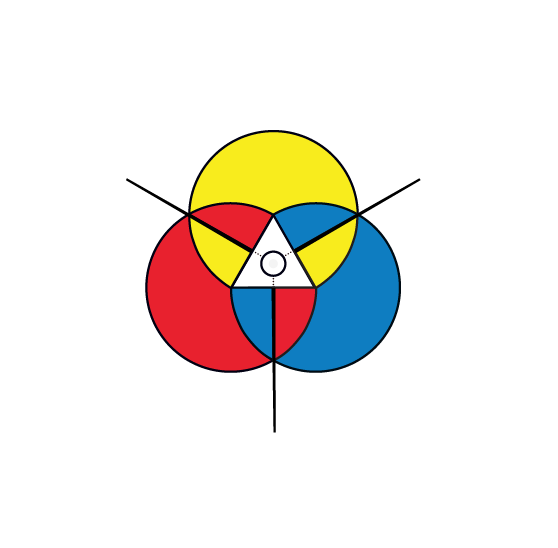

The History of the Founding of Minh Ly Dao
Minh Ly Dao was founded in the year Giap Ty (1924). More than a hundred years have since passed, with successive generations of disciples continuing the work of building and perfecting the organization, studying, cultivating virtue, and practicing self-cultivation. Minh Ly Dao has passed through the following periods:
1. First Period (1924–1964): Establishing the Doctrine and Organizational Structure
The first 16 years (1924–1940): the period of spiritual communication (thong cong)
In the early 1920s, a group of seven civil servants and private employees regularly gathered to pool funds for printing popular scriptures, and gradually developed a devotion to studying the scriptures of the Three Teachings. One member of the group, Mr. Au Kiet Lam (religious name Minh Chanh), practiced as a medium (dong tu) to invoke the Buddhas and Immortals to teach the Way, and later became the first Abbot (Chu Tri) of Tam Tong Mieu temple.
The official founding séance was held on the 27th day of the 11th lunar month of the year Giap Ty (1924, during the Mau Ty/Binh Ty hours), when the Patriarch of the Way, Thai Thuong Lao Quan, descended, bestowing the religious name Minh Ly and the scripture “Tang Ngoc De” (Offering to the Jade Emperor). This day is commemorated as the Founding Anniversary of Minh Ly Dao; the seven founders mentioned above are honored as the pioneering forebears of the faith.
In 1925, the Patriarch of the Way instructed the founding of a temple; Minh Ly Dao built Tam Tong Mieu, moving into the new temple in 1927, with major renovations in 1941 and 1957. In 1926, Dieu Tri Kim Mau Vo Cuc Thien Ton (the Golden Mother of the Jasper Pool, Boundless Celestial Venerable) bestowed the temple’s name, Tam Tong Mieu (“Shrine of the Three Teachings”) — a temple dedicated to the three teachings of Confucianism, Taoism (Immortals), and Buddhism, with the purpose of seeking the return to the One Way, the One Throne, which is God (Thuong De).
During this period, Minh Ly Dao also: registered the founding of the Tam Tong Mieu Mutual Aid and Self-Cultivation Association (1926, approved 1927); established the Tam Tong Mieu Cemetery (now Bao An Tu, 1926); opened the Hiep Ich vegetarian goods shop; established a Free Medicine Dispensary and Free Clinic (1927–1928); established a Scripture Publishing Institute (1927); produced a lunar-solar calendar annotated with holy-day observances — the forerunner of the Tam Tong Mieu Calendar (1927); founded the Tam Tong Printing House and the Duc Mon Publishing Society, and opened a free school for underprivileged children (1930).
The following 24 years (1941–1965): Independent Study and Cultivation — Research into the Scriptures of the Three Teachings
In 1941, the medium Minh Chanh passed away, and the channel of spiritual communication was severed; disciples were left to cultivate and study on their own amid financial hardship. Venerable Dinh Phap Nguyen Minh Thien (1897–1972) devoted himself wholeheartedly to steering the faith forward: compiling the Holy Teachings (Thanh Ngon), writing books, translating scriptures, restoring the Sacred Temple, and composing Minh Ly Hoc Thuyet (The Doctrine of Minh Ly) as the foundation of its teachings.
Key milestones: re-establishment of the Women’s Order (1952); rebuilding of Tam Tong Mieu (1957–1961); founding of Xuan Phong Primary School (1961); improvement of the Tam Tong Mieu Calendar, which became renowned throughout southern Vietnam for its accurate seasonal forecasts and daily maxims encouraging cultivation.
2. Second Period (1965–1972): The Founding of the New Doctrine
On the 8th day of the 9th lunar month of the year At Ty (October 2, 1965), the Supreme Lord (Duc Chi Ton), the Patriarchs of the Three Teachings, and all Buddhas, Immortals, Saints, and Spirits descended at the altar to witness the opening of the Prayer Scripture ceremony, bestowing authority and doctrine, and formally proclaiming the New Doctrine of Minh Ly Dao (Tan Phap Minh Ly Dao). On October 6, 1965 (12th day of the 9th lunar month, At Ty), Duc Dong Phuong Lao To (the Eastern Patriarch) taught: “From this day forward, Minh Ly is no longer confined to the scope of an association or society, but has become a Church of the Central Branch of the Great Way (Giao Hoi Trung Tong Dai Dao).”
That same year, 1965, Heaven bestowed two important scriptures, Minh Ly Chon Giai and Dao Hoc Chi Nam (Compass of Religious Studies), as guiding lights for study and cultivation. Between 1966 and 1971, Venerable Minh Thien built Bac Nha Tinh Duong as a place for meditative cultivation. The Minh Ly Youth Corps was founded (1969); a Women’s Deaconate was established to lead the Women’s Order (1972); translated scriptures were printed for distribution (Dao Duc Kinh, Thanh Tinh Kinh, Huynh Dinh Kinh, and others) alongside compiled works (Minh Ly Chon Giai, Chu Dich Huyen Giai, Dao Hoc Chi Nam, Bac Nha Khai Mon); a charitable medical clinic was established (1969); and two schools handed over by the Popular Education Association came under its management (1966).
3. Third Period (1975 to the present): Advancing Minh Ly Dao
After national reunification, disciples continued to cultivate according to the methods taught by the Immortals and Saints and by Venerable Dinh Phap Minh Thien, overcoming many difficulties to develop the faith further.
On August 17, 2007, the Government Committee for Religious Affairs granted religious activity registration to Minh Ly Dao Tam Tong Mieu. On October 1, 2008, the Government Committee for Religious Affairs issued Decision No. 195/QD-TGCP officially recognizing Minh Ly Dao – Tam Tong Mieu as a religious organization (operating in Ho Chi Minh City, Long Hai, and Long An) — one of the first sixteen religions officially recognized in Vietnam.
Religious activities have since expanded to include: fraternal relations with other religions within the community and through the Interfaith Dialogue Pastoral Committee in Ho Chi Minh City; charitable and social work, including the operation of a charitable clinic; the printing and distribution of scriptures; the organization of doctrinal classes for disciples; the holding of meditative cultivation retreats; scouting and mentoring activities for the Minh Ly Youth; joint camping activities with fellow sanctuaries; and shared doctrinal study with other sacred houses and sanctuaries.