

CONCLUSION
CHAPTER FIVE
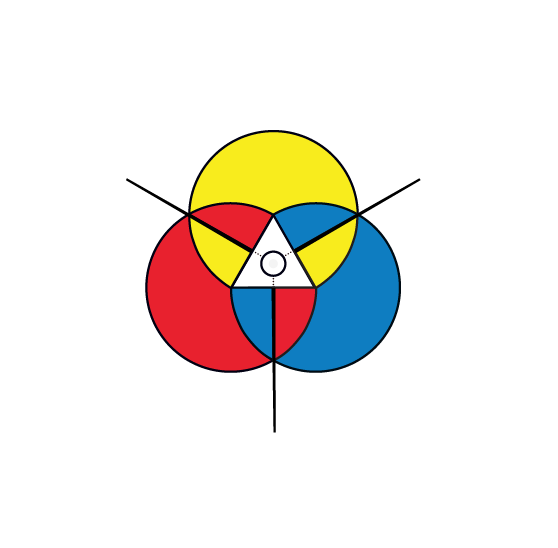
“Tam tai nhut ly, Tam giao nhut tam,” meaning: Heaven, Earth, and Humanity share but a single principle; Confucianism, Buddhism, and Taoism share but a single heart. This is the concluding statement of this book. But principle resides within the heart, and the heart never departs from principle. Thus, when the Three Teachings and the Sages discourse upon the heart, their sole purpose is to seek principle.
Master Chou Lien-hsi (Chau Liem Khe, of the Confucian tradition) proposed the saying: “Thanh nhon chu tinh lap nhon cuc,” meaning: The Sage takes stillness as the foundation for establishing the highest standard of humanity. Here, “stillness” (tinh) means acting in accordance with principle. Thus, even when the heart is busily engaged in responding to countless affairs, it remains still. Conversely, when following desire, even if the body sits in quiet meditation forgetting all else, the heart remains in motion.
The alchemical scriptures say: “Dong trung luyen than,” meaning: refine the spirit within motion. The spirit must be still; yet to seek stillness, one must search for it at its very source, which is motion.
The Sixth Patriarch further said: “Nhuoc mich chon bat dong, dong thuong huu bat dong. Bat dong chi bat dong, vo tinh vo Phat chung,” meaning: If you wish to find true non-motion (that is, stillness), that non-motion exists within motion itself. But if you understand non-motion to mean doing nothing at all, then this is the non-motion of insentient things (like earth or stone) — not the seed from which Buddhahood may grow.
Although the Three Teachings all teach the practice of stillness, true stillness contains motion in accordance with principle. Yet most people tend to look down upon this genuine practice of stillness, preferring instead a passive stillness. Passive stillness means remaining idle and doing nothing at all, becoming a “stubborn emptiness” (ngoan khong) — a dry, barren emptiness incapable of generating or transforming anything. Cultivating in this manner can achieve only a lesser fruit of attainment.
Cultivating merit and virtue is truly the active practice of stillness. All the Bodhisattvas have followed this very path, proceeding directly to the realm of Nirvana, the Land of Ultimate Bliss.
Nirvana, the Land of Ultimate Bliss, is not a physical place with form, as many mistakenly believe. It refers to a spiritual realm within the human heart-mind, comprising three great virtues: luminosity (complete with every kind of merit and virtue), freedom (unconstrained by desire), and peace and joy (finding contentment in every action one performs).
The Buddha, wishing to open the true understanding and vision of sentient beings, entered into this worldly realm for that very purpose. If a practitioner fails to understand this and instead continues chasing after worldly, tangible happiness in the manner of ordinary people, then not only will they ultimately be disappointed, but they will also encounter much suffering and misery besides.
It is certainly true that the principle of the Way is lofty and profound, and that we, still living amid this world of the Five Turbidities, cannot follow this principle in its entirety. Yet we should always remember the Buddha’s teaching: “All things are created by mind alone,” and continue diligently to cultivate the field of our own heart-mind. The Analects (Luan Ngu) likewise states: “Chanh ky nhi vat chanh,” meaning: Rectify yourself, and the things around you will naturally become rectified as well.
If our own heart-mind becomes good, then our body and our surrounding circumstances will likewise transform for the better. At first, this may seem difficult to us, but afterward even difficulty turns to ease. There may be times when, outwardly, we cannot fully follow the true principle — yet inwardly, at every moment, we must nevertheless strive always to hold fast to it.
The ancient scriptures say: “Noi phuong nhi ngoai vien,” meaning: Square within, round without. This means: within, one must cultivate the absolute principle (that is, hold firmly to a single, unchanging standard, like a square resting fixed in place); while without, one must cultivate the relative principle (that is, adapt flexibly, turning and revolving with the times, like a circle rolling and moving everywhere). Duc Thai Thuong’s use of the hexagram Trach Loi Tuy (Lake over Thunder, “Following”) to explain the two words “Minh Ly” carries exactly this same meaning.
Because of this very principle of “Following” (Tuy), the three great Founders of religion each established different methods for guiding sentient beings: some employed concrete practice, others principle; some taught action (huu vi), others non-action (vo vi); some discoursed on the existence of spirits, others on their non-existence.
Though the methods are many, none go beyond the two great principles: investigating things and extending knowledge, both aimed at illuminating Rational Nature — that is, at Minh Ly itself.
As explained above, apart from those of the highest capacity, people of middling and lesser capacity must proceed in proper sequence, step by step. That is to say, they must divide their study into several stages. This, too, follows from the principle of “Following.”
Within the Three Teachings, each doctrine has its own particular strength:
- At first, one cultivates Nature — yet one’s own nature at this stage is still yin nature, belonging to the Posterior-Heaven. This is the first stage, in which the student still follows worldly methods, and so takes Confucianism as the foundation.
- Next, one cultivates Destiny, refining Posterior-Heaven energy so that it returns to the Prior-Heaven, restoring the Lo Shu (Luo Book) back into the Ho Tu (River Chart). At this middle stage, the student relies upon the principles of the Book of Changes, taking the Taoist practice of the Golden Elixir as the central pillar.
- Finally, one returns once more to cultivate Nature, and only then attains complete liberation. At this highest stage, the student must devote themselves to the Chan (Zen) school of Buddhism: “Pointing directly at the human heart-mind, seeing one’s nature and becoming Buddha.“
For any single doctrine of the Way to be truly complete, it must encompass all these particular strengths together. Should the Three Teachings, then, be unified into one?
Here, we have chosen only to explain the commonly practiced methods for actual application. So long as one truly understands them and applies them wholeheartedly, the practice of this first stage of study will surely bear fruit. We ask the reader not to hastily dismiss these methods without considering their great practical usefulness, difficult though it may be to explain them fully in theoretical terms.
If there are those who do not yet fully understand the methods described, yet wish to practice earnestly; or who find it inconvenient to practice these methods at home; or who lack sufficient willpower to cultivate alone — to such people, we recommend frequently visiting the temple: first, to pay reverence to the Buddhas and Heaven, and to listen to scriptures and sermons; and afterward, to draw close to one another, reminding and encouraging each other in the practice of cultivation.
We wish to repeat here the closing passage of the Bo Cao scripture of Minh Ly Dao:
The House of Minh Ly is the common foundation of all religions,
Without favoring or disfavoring the Three Teachings or the Nine Schools.
All religions share the same earnest aspiration,
Following the true path, the monk cultivates mindfulness.
Do not harbor a heart of jealousy and slander,
Neglecting to examine and turn back to oneself.
Rather, support one another in mutual love and mutual seeking,
Striving diligently to fathom the subtle mechanism and profound principle.
Because delusion blocks the nine apertures,
People find it hard to comprehend the Way of Heaven.
And so error arises everywhere,
Let us hasten together toward awakening.
These are sincere words — may all worthy and noble persons take heed!