
EQUALITY – COOPERATION – HARMONY
The fifteenth day of the seventh lunar month, year Tan Hoi (1971)
NGUYEN MINH THIEN
I. INTRODUCTION
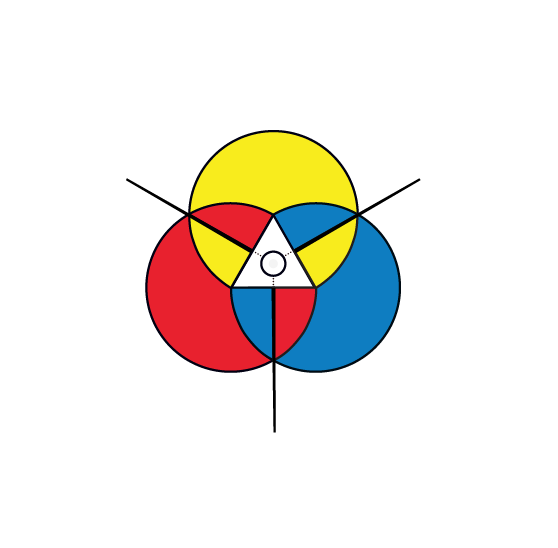
The motto (devise) of Minh Ly Dao rests upon three pillars: Equality – Cooperation – Harmony.
The word tieu also means a raised banner or standard. The word ngu properly means “words” or “speech.” Together, here it means a phrase or set of words. The two syllables “tieu ngu” together mean a phrase, or a set of words, that proclaims the true purpose and lofty aspiration of a lineage or branch, so that each member may grasp its essence, keep the purpose of their lineage or branch in mind, and act accordingly.
II. EQUALITY
Binh means: level and even, without unevenness or difference in height, like the surface of a pond or lake when the wind is still. Dang means: rank, order, level. Combined, “equality” (binh dang) means being level with one another, of the same rank, without higher or lower, greater or lesser.
In worldly terms, “equality” means that before the law — in religious, political, economic, and other matters — all people are alike. But one might ask: how many nations have truly implemented this principle? For prevailing laws are merely laws established by worldly society based on ordinary human sentiment, and are largely deficient, since they seek only to understand function while paying little attention to essential substance.
That essential substance is the Dao — Innate Knowledge, Innate Ability, Heavenly Truth, Buddha-nature — that is, the Primordial Origin, the very source of Heaven, Earth, and Humanity (the Three Powers).
Everyone equally possesses the Dao within them, or an equal Original Nature; every person resembles every other, being fundamentally one, without duality. Thus, in this world, only this original substance is truly equal and eternally existent; everything else — the phenomena of the myriad things — is entirely differentiated and ceaselessly changing.
Buddhist scripture calls this original substance “unchanging yet manifesting according to conditions, manifesting according to conditions yet unchanging” — meaning: the original substance never shifts or changes, yet when conditions arise, it manifests; and though it manifests according to conditions, it nevertheless remains unchanged.
Now, if we wish to select a true object of equality, we must take this original substance, for only it truly possesses the nature of equality, and only it is eternally existent and unchanging.
III. COOPERATION
The word cong (co-) means: uniting two or more differing components to form a single, comprehensive, and great result — also called “joining forces” (hiep tac). Tac means action, activity. “Cooperation” (cong tac) means: many people, of varying strength, joining hands together to accomplish a weighty task.
The Dao Hoc Chi Nam (Compass of Religious Studies) offers an illustrative example: “A beautiful garden is a gathering of countless individual elements — from the tiniest pebbles, to the hazy blue-green water winding beneath rows of brightly colored flowers, beneath stately clusters of pine and cypress. This harmonious union, free of contention, creates a setting that blends color and fragrance together, forming a single serene idea for the beholder to contemplate.“
It is not only beings of this earthly realm that must unite with one another; even the celestial realm and the earthly realm, Heaven and humanity, must cooperate together for there to be true joy and beauty. This form of cooperation is called “Thien nhon hiep nhut” — Heaven and humanity united as one.
An ancient saying states: “Nhut bon tan van thu, van thu qui nhut bon,” meaning: the myriad differentiated things scatter from a single root, and the myriad differentiated things return again to that single root. Without cooperation, how could this return to unity, this return to the Dao, ever be achieved? Fellow believers must always keep the two words “Cooperation” in mind, for only then can we attain our purpose. We must never, for any reason whatsoever, allow ourselves to become hostile toward or divided from one another, for in doing so we would only imprison ourselves within the cycle of birth and death.
Moreover, we cooperate for a lofty, righteous purpose, of benefit to all people, to the whole of human society — not for personal gain, nor to seek wealth and status for ourselves alone.
The Dao Hoc Chi Nam further states: “Cooperation without harmony cannot truly be called cooperation at all. Only when united within an atmosphere of harmony can the desired result be achieved. Cooperation and harmony are as form and shadow. Cooperation is the house; harmony is its foundation.“
IV. HARMONY
1. The word “Hoa” (Harmony)
Hoa means to be in accord with one another, to unite joyfully together. Its opposite is a divided heart, one of mutual opposition and contention.
In this world, every person possesses a different temperament. To achieve harmony, it cannot come from only one side alone. All must share a common resolve, sacrificing minor matters while firmly upholding what is essential — that is, choosing a shared purpose to devote themselves to. Our present temperament is by no means our natural, Heaven-endowed nature, but is merely the product of long habituation. Whoever possesses a strong and courageous will can gradually train themselves, discarding old, unwholesome habits, and thereby return to their original goodness. Buddhism calls this method of cultivation “permeation through practice” (huan tap).
The Dao Hoc Chi Nam states: “Harmonious union does not mean abandoning oneself to the crowd, drifting passively through life. To unite harmoniously with others, without actually striving toward one’s established purpose, is a harmony that does not deserve its true name.“
2. The word “Ai” (Loving-kindness)
Ai means to love others, regarding them as one’s own body, one’s own hands and feet. But the “Ai” spoken of here is not the ordinary, narrow love confined to oneself; rather, this love must extend impartially and widely to encompass society, humankind, and all people under heaven.
The Dao Hoc Chi Nam states: “A noble and sacred love can resolve the countless troubles of human life.” The best course of action is to judge others less, to love others more, and to guide them so that all may progress together.
Thus, the two words “Harmony” (Hoa Ai) form the sole path toward the ultimate goal of the Way. Only when worldly life and religious life support one another can the state of Great Harmony — the Paradise of Ultimate Bliss — be established here in this earthly realm. Hence the poem:
Loving-kindness embraces all beings,
Nurtured and preserved by a single hand.
Rain and dew pour forth amid the world’s upheavals,
Boundless grace showers down as the age transforms.
A stream runs dry when far from its original source,
A flame burns low when the household lacks fuel.
Knowing the Way, knowing others, cultivating with awareness of one’s place —
Great Harmony among all beings could then never fail.
V. CONCLUSION
The motto of Minh Ly Dao rests upon three pillars: Equality – Cooperation – Harmony.
Elsewhere, people raise up the word “Freedom” — yet without Equality, how could Freedom ever be attained? Thus Freedom and Equality serve as cause for one another. As for universal love (Bac Ai), Minh Ly’s “Harmony” (Hoa Ai) means blending and harmonizing — merging oneself with all humankind as one — and only thus does one truly attain the ultimate goal of universal love, the ultimate goal of the Way.
I sincerely hope that fellow believers will pay close attention to the motto of our faith and strive earnestly to fulfill it, for only then shall we preserve and advance the path of Minh Ly entrusted to us by the Three Founders. Hereafter, our happiness — and the happiness of all humankind — shall likewise spring forth from this very motto.
With utmost sincerity of heart.