
PRELIMINARY REMARKS FOR UNDERSTANDING THE MEANING OF MINH LY DAO’S FIRE-TIMING DIAGRAM — ON THE FIRE-TIMING OF MINH LY DAO
FIRE-TIMING (HOA HAU)
A. PRELIMINARY REMARKS FOR UNDERSTANDING THE MEANING OF MINH LY DAO’S FIRE-TIMING DIAGRAM
I. SYMBOLISM
This diagram is a symbolic chart — that is, it uses a visible, tangible object to explain an invisible, intangible principle. The two sides are therefore only roughly analogous to one another, not truly identical in every respect.
Suppose, for instance, one wished to describe the form of a dragon, yet almost no one has ever seen a dragon — so we must borrow the form of a snake, a creature we commonly see, to explain it quickly. But a snake is merely a crawling creature of a certain length… resembling a dragon only roughly, certainly not truly identical to it. We must therefore seek further understanding — that the dragon also has scales, has legs, ascends to Heaven to make rain, and descends to the sea to make waves, and so on.
It is no different in the Book of Changes, where the eight trigrams are drawn using only a solid line and a broken line, symbolizing the two energies of yin and yang — having odd number as solitary, even number as paired; or having male and female, man and woman.
Why is a broken line called yin, and a solid line called yang? As I said above, this is merely a rough resemblance, not a true likeness. Let fellow believers reflect further and seek to understand in what respect they truly resemble one another.
The scriptures of the Three Teachings frequently emphasize this very point. One should therefore never take an analogy as complete literal truth — it stands correct only from a certain angle; shift to another angle, and it becomes incorrect. To read scriptures while clinging rigidly to the literal text — that is, fixating on only one angle — is, according to Mencius, most harmful to the Way.
1. ON GOD IN THREE PERSONS
According to modern philosophy, the human Mind is recognized as having three great components: WILL, INTELLECT, and EMOTION. I have therefore written these three words within the three large circles of the Diagram — though when Heaven originally bestowed this Diagram, there were no words inscribed at all.
If we insisted on keeping these three exact words fixed permanently within the Diagram, then when explaining it in relation to some other doctrine, it certainly could not always be entirely accurate. But to say that every doctrine possesses these same three great components, merely under different names, with meanings sometimes broader, sometimes narrower — this is not at all incorrect.
- Christianity calls this the Holy Trinity: God the Father, God the Son, and God the Holy Spirit.
- Hinduism likewise speaks of a Divine Trinity: Brahma, Vishnu, and Shiva.
- Buddhism speaks of the Three Sacred Ones — Amitabha, Mahasthamaprapta Bodhisattva, and Avalokitesvara Bodhisattva, according to the Pure Land school; or the Three Virtues — Vairocana, Locana, and Sakyamuni, according to Tibetan Esoteric Buddhism; or the Three Bodies — Dharma-body, Reward-body, and Transformation-body, according to the Mahayana.
- Taoism speaks of the Three Ultimates — the Boundless Ultimate, the Supreme Ultimate, and the August Ultimate, in reference to the universe; or the Three Pure Ones — the Jade Purity, the Highest Purity, and the Grand Purity, in reference to the microcosm.
- Confucianism speaks of Heaven’s Mandate, the Way, and Teaching, according to the Doctrine of the Mean; or of Destiny, Nature, and Principle, according to the texts on Nature and Principle. It also uses the terms Heaven, August Heaven, and the Supreme God (Thuong De).
Though the terms of veneration differ, each doctrine following its own system, the underlying reality is essentially the same in every case.
Minh Ly Dao likewise speaks of a Trinity, that is, the Three Ultimates described above, venerating three beings — Dieu Tri Kim Mau, Ngoc Hoang Thuong De, and Hong Quan Lao To — as representatives of the Three Ultimates, who founded Minh Ly Dao. In earlier times, other traditions also venerated these three beings, but separately and individually, without uniting all three together as joint representatives in this manner — perhaps because the proper time had not yet come. For in earlier ages, few spoke of the August Ultimate at all, and even when mentioned, it lacked clear definition and ordering. The present age is precisely the age of the August Ultimate.
Let it be clearly stated: Minh Ly venerates these Three Beings as representatives of the Three Ultimates, in the following order:
- Dieu Tri Kim Mau (the Boundless Ultimate)
- Ngoc Hoang Thuong De (the Supreme Ultimate)
- Hong Quan Lao To (the August Ultimate)
Minh Ly Dao by no means claims to fully comprehend every religion, or to encompass and subsume all faiths within itself. Rather, Minh Ly Dao, through a systematic Diagram bestowed by Heaven, allows the student to understand in broad outline the doctrine of their own faith, to trace it back to its source, and, following that same system, to seek understanding of other faiths as a supporting aid.
2. YET THE THREE PERSONS SHARE A SINGLE ROOT
On the other hand, from where do these three large circles originate — do they not emerge from the white triangle at the center?
Divided into three, we speak of three Persons; united, there is but one root. Yet according to each particular doctrine, this root is called by many different names — God, Adi-Buddha, the King of Majestic Sound, the Supreme God, True Reality, Original Substance, and countless others too numerous to list.
Yet grasped in spirit, is this not simply ONE Sovereign Lord governing the entire universe? Could it possibly be that, within a universe as vast as this — with sun, moon, and stars revolving according to fixed law — there is no sovereign authority at all? How, then, could it endure for so long? Although collisions and conflicts occur at times, in the end all things return to harmony and stability; disorder is followed once more by proper order.
Though in their details, various doctrines understand this principle differently, depending on whether their authors are optimistic or pessimistic by temperament, in reality, however chaotic this world may become, it can never truly be annihilated: disorder followed by order, order followed by disorder — this is merely the mechanism of change and transformation, of generation and completion, as described in the Book of Changes.
Without this process of sifting and selecting, without periods of suffering and periods of peace, how could the true worth of a person ever be known — whether one is a noble person or a petty person, a hero or a coward? Hence the saying: “In a nation’s turmoil, one recognizes the loyal minister; in a family’s poverty, one recognizes the filial son” — how true this is! Though external circumstances may change, if one’s heart remains ever loyal and steadfast, diligently cultivating oneself and refining one’s virtue, becoming a worthy citizen, then one will surely enjoy blessing in time. But to grow weak and despondent before hardship, troubled and confused within, resolves nothing — it only makes the hardship grow greater still.
3. ALL THINGS EXIST BECAUSE OF GOD
God is the original source of creation and transformation, taking Principle as Nature, and taking the energies of Yin-Yang and the Five Elements as the body for every person and every thing. This Principle is the Primordial Principle, identical with the Primordial Principle of God Himself.
Regarding this principle of nature, all are truly identical; the difference lies only in the body. Thus, human nature, obscured by the material desires of the flesh, cannot attain the same luminosity as God. For this reason, sentient beings remain caught within the cycle of birth and death, drifting ever farther from their original source, uncertain when they may ever return to reunite with Heaven.
In the Diagram, we see three colors — Yellow, Blue, and Red — which then blend together, like the six segments of a tangerine, forming yet other colors — Green, Purple, Fiery Orange, and so on. Does this not signify: Heaven giving birth to the universe, to countless numbers of people and things beyond reckoning? Is this not precisely the meaning of the saying: “From a single root, ten thousand differences scatter forth” — that is, from one single root springs forth boundless, differentiated multiplicity?
4. AND THEN PEOPLE AND THINGS RETURN TO GOD
Why do people and things become separated from God, only then to have to return to God once more?
This is a central question in every religion; though the manner of explanation differs, every faith equally teaches a return to God, or to the Buddha.
- Some say it is due to ignorance — for ignorance is a self-inflicted darkness, and one must cast off desire to seek one’s original nature.
- Some say it is in order to learn and to evolve.
- Some say it is the cyclical law of Heaven, requiring departure and return, descent and ascent, and so on.
- Some say the universe is so vast and boundless that it surely could not lack people and things.
I shall not answer these particular questions here, as they belong to matters of detail, which each person should seek and study according to their own level of understanding. Above, it was said: “From a single root, ten thousand differences scatter forth” — and is it not equally true here that “The ten thousand differences return again to a single root,” meaning that boundless differentiation returns once more to a single source?
Minh Ly Dao calls this: RETURNING TO THE ROOT, RESTORING THE ORIGIN (Phan Bon Huon Nguyen).
I ask fellow believers to reflect upon these five points above, and I believe understanding the meaning of the Fire-Timing Diagram will then not prove so difficult.
Let me summarize the points made above:
- Within nothingness, there is being.
- That being is utterly luminous — it is God, possessing boundless virtue and merit.
- That being gives rise to and transforms countless sentient beings.
- For what purpose do sentient beings descend into this world?
- How must one act in order to return to one’s original throne, one’s former place?
B. ON THE FIRE-TIMING OF MINH LY DAO
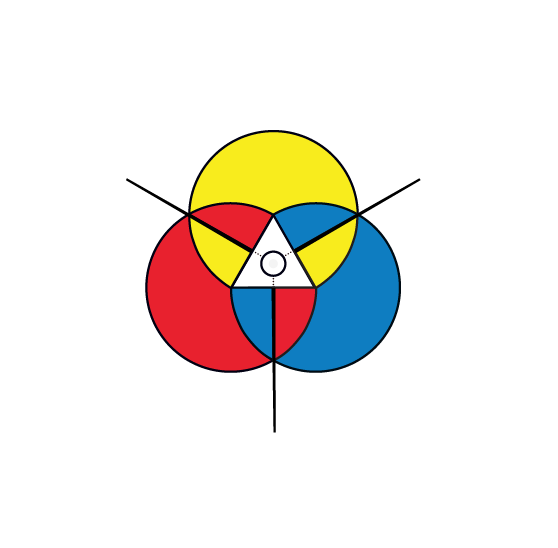
Today is the anniversary of the Founding of Minh Ly Dao. As is customary, I shall deliver a sermon on virtue, to remind fellow believers of the method of self-cultivation and religious practice. The subject to be discussed today is the explanation of the fundamental diagram, also called the FIRE-TIMING OF MINH LY DAO — that is, the emblem displayed atop the roof of Tam Tong Mieu temple. Every disciple of Minh Ly must understand the meaning of this emblem.
I. ORIGIN
It was the Patriarch of the Way Himself, Duc Thai Thuong, who, at the very founding of the faith, entrusted Confucius, Van Tuyen Vuong, to bestow this emblem upon Minh Ly Dao. At the time of its bestowal, Confucius said: “This diagram was once given to the Western lands, but no one there knew how to make use of it.“
He gave a brief explanation and further instructed each person to strive to research it further. But with our own limited understanding, even a whole lifetime of study may still not suffice to grasp it fully, without Heaven opening our minds and helping to explain it.
In explaining the Fire-Timing here, I can, in truth, only convey a rough, superficial portion of its meaning. According to Heaven’s teaching, the full meaning of the Great Way is entirely contained within it. Thus, the more we study it, the more we shall discover its marvelous, boundless meaning.
II. THE MEANING OF THE WORDS “FIRE-TIMING” (HOA HAU)
First, let me explain the two words “Hoa Hau.” Hoa means fire; Hau means the proper timing, the hour. Combined, these two words mean “the proper hour for applying fire.”
According to the method of religious cultivation, each stage differs from the next — one does not use a single, fixed method throughout the entire practice. It is no different from a student attending school, beginning in a lower grade and gradually advancing to higher grades, each grade bringing further progress.
Minh Ly Dao has five stages of study: Preparation (Du Bi), Initial Foundation (So Co), External Medicine (Ngoai Duoc), Internal Elixir (Noi Don), and Spiritual Transformation (Than Hoa) — the latter three being the truly essential stages, through which the practitioner must progress in proper order, one after another, until reaching the ultimate fruit of realization. This is the meaning of “Ranked Levels” (Cap Dang).
Furthermore, within each stage, each day of study follows a set schedule — that is, a fixed timetable of subjects, specifying what is to be studied at what hour, and when to rest and relax. Let me illustrate this with the example of cooking rice.
One who cooks rice must know when to build up a strong fire, when to reduce it, and when to extinguish the flame, leaving only glowing embers. If the fire is not tended properly, the rice will be undercooked, burnt, or dried out and charred.
The method of religious cultivation is exactly the same: at each stage of practice, the fire (that is, one’s effort) must be applied correctly and at the proper time, neither excessive nor deficient, for the elixir to be successfully formed. Err by even the slightest hair’s breadth, and one goes astray by a thousand miles. Hence the alchemical scriptures say: “Success in refining the elixir depends entirely on the fire-timing” — meaning that success in refining the elixir comes only to those who understand fire-timing and cultivate accordingly. This may be called the meaning of “Refining Practice” (Phanh Luyen).
The two meanings described above are exceedingly detailed, understood fully only by those who have studied the esoteric practice (Huyen Cong). The third meaning — that of “Returning to the Origin” (Qui Nguyen) — is the true, central purpose of Minh Ly Dao.
Regarding this final meaning, Confucius taught: “If a person wishes to return to their old homeland, they must first know by which road they descended here, and must follow that very same road back, lest they lose their way.” Written out in full, this meaning is also called “Returning to the Root, Restoring the Origin” (Phan Bon Huon Nguyen).
Because we have forsaken our true self and dissipated our vital energy, drifting ever farther from our root day by day, we have come to suffer degradation. Now that we have encountered this diagram, we should follow the method of the faith to trace our way back to our former root, our original throne. Where is this former root, this original throne? It is the single point within the small circle at the very center of the diagram — that is, God.
III. THE MEANING OF THE FIRE-TIMING DIAGRAM ACCORDING TO WESTERN THOUGHT (A brief discussion according to various doctrines)
According to Western thought, this emblem is a diagram of the Holy Trinity. The Trinity means that God, being a single Being, possesses three great Attributes, and on this basis, three Persons are established separately for ease of distinction.
1. THE TRIANGULAR SHAPE
The shape at the center, in white, consists of a triangle, a small circle, and a single point at the center, symbolizing the Person of the Godhead, encompassing all three attributes together, not yet separately distinguished. Because these three attributes remain latent, not yet expressed outwardly, they retain the pristine wholeness of the unified Person, as though there were but one.
This is the Person of the Godhead, or the Person of Original Substance. This Person emerges from within the absolute Person of the Void (Christianity does not recognize this, holding that God exists first and foremost) — that is, from the Person of No-Substance. These two Persons are not truly separate from one another, but are merely two aspects of a single numinous substance.
- The white color symbolizes the Person of the Void, for it pervades everywhere; though various colors appear distinct, they all converge at the center into a single white color.
- The triangular shape symbolizes the God of Substance, divided into three attributes. Though these three attributes remain latent, they have already begun to take on form (extremely subtle form).
The book The Celestial City (La Cite celeste) by Dr. Fugairon states (in Vietnamese translation): The Dao possesses the power to manifest itself as a boundless numinous substance, encompassing all other powers within it. There is a first power, which, by and of itself, arises from nothingness into complete being, without boundary; born of itself, dependent on no other power, and encountering no obstruction, thus achieving the fully complete numinous substance in an absolute manner — this is God.
The book Abrege de la Doctrine secrete by Madame Blavatsky, President of the Theosophical Society, likewise states (in Vietnamese translation): The First Person, or the sole Person of the Dao, anciently called the “Circumference” of Heaven, is symbolized by a point at the center of a circle (circumference), or within a triangle (with three equal angles). This point is called the Logos, the Spirit, God.
According to Christianity, the Logos is the Second Person of God.
Outside the central triangle, surrounding it, are three large circles — Yellow, Red, and Blue.
2. THE LARGE YELLOW CIRCLE
Within the first large circle, colored Yellow, at the top, you will see the word Will (Volonte) — this is the First Person, one of the three Persons of God.
From within the Void arises Being; from non-awareness arises awareness; the Person of God takes form, becoming self-aware — for a numinous substance can only manifest its true reality and act as an individual being once it becomes aware of its own True Self (conscience de Soi).
The first time the Person of God manifests Himself is precisely the First Person, with no other being than Himself to present any obstruction — so that this manifestation occurs in complete freedom, achieving whatever is willed entirely according to His own desire. This Person therefore possesses the strongest Will of all, hence the word “Will” is inscribed there.
Philosophers and moral theologians have long debated whether God possesses will or not. Considered as the Person of the Void (Dieu principe), there is indeed not yet any will. But once He manifests Himself as a numinous substance, He possesses all attributes fully, as any individual being does, differing only in that these attributes are perfected to the utmost degree — so to claim that God has no will at all would be unreasonable.
This Will spoken of here does not exist entirely alone by itself; it is also accompanied, to some degree, by luminous Intellect (as in the Second Person) and Emotion (as in the Third Person), to be discussed below. But within the First Person, these latter two attributes are somewhat weaker; hence, within the large yellow circle, the word “Will” is accompanied by two smaller segments, red and blue (like tangerine segments), symbolizing that these two latter attributes are proportionally smaller here.
Christianity calls this Person (Will) God the Father (in Greek, Arche).
3. THE LARGE RED CIRCLE
Within the second large circle, colored Red, on the left, is the Second Person. Once the First Person has become self-aware, it naturally follows that He also becomes aware of that which is not Himself.
That which is not Himself, spoken of here, is the Person of the Void (No-Substance). After God the First Person manifests Himself, He leaves behind a portion of ethereal substance (substance ether) within it, still latent, not yet expressed outwardly.
According to Fugairon’s theory, creation and transformation require God’s stimulating action. Though we speak of God “creating,” in truth, He merely applies the method of stimulating the Person of the Void. If God the First Person is called Father, then the Person of the Void becomes the Mother of Life (Mere de vie, or Cenone).
Within the Void lie all the Principles that must be understood. God, wishing to understand these Principles as distinct from Himself, unites His Will with these Principles, and from this union arises divine, sacred light — the science of creation — that is, Wisdom. Hence it is said: Will gives birth to Wisdom, or in other words: the First Person gives birth to the Second Person.
God’s Wisdom perceives through intuition, in an exceedingly simple manner. He thereby distinguishes this idea from that idea, one idea inferred from another, coming to know the relationships among ideas, and so forth — this perception being true, perfect knowledge. Thus, within the Second Person, the aspect of Wisdom predominates, hence the word “Wisdom” (Sagesse) is inscribed within this large circle, accompanied likewise by two small segments, yellow and blue, symbolizing Will and Emotion.
Christianity calls this Person (Wisdom) God the Son (in Greek, Logos).
4. THE LARGE BLUE CIRCLE
Within the third large circle, colored Blue, on the right, is the Third Person.
As said above: once God wishes to know, and has truly come to know, He then possesses Emotion (Sentiment or amour), bringing forth love for all that has been known. This Emotion is born of Will and Wisdom — that is, it arises from the union of the First and Second Persons.
This Emotion is a form of pure, tranquil joy (a noble and lofty happiness), arising from a single root dividing into ten thousand differences, which then return once more to a single root. It is like the breath, exhaled and inhaled, that constitutes the very life of God.
Within the Third Person, loving compassion predominates above all, hence the word “Emotion” is inscribed within the large blue circle. Because this Emotion carries within it both luminous Wisdom and Will, it too is accompanied by two small segments, yellow and red, as symbols.
Christianity calls this Person (Emotion) the Holy Spirit (in Greek, Zoe).
Allow me to summarize once more: God, emerging from the Void, possesses three Persons: Truth, Science, and Life. These three Persons are not merely distinct — each possessing a single Attribute (either Will, or Wisdom, or Emotion) — but are also interrelated, called God the Father, God the Son, and God the Holy Spirit.
- Why is the First Person called the Father? Because this Person gives birth to the Second Person.
- Why is the Second Person called the Son? Because this Person is born of the Father.
- Why is the Third Person called the Holy Spirit? Because this Person is born of the union of the two preceding Persons, like the very breath shared between them — hence also called the Breath of Life (Souffle de vie).
Thus, within a single substance of God, there are three clearly distinct roles: God as Truth is the Father; God as Science is the Son; God as Life is the Holy Spirit.
Though divided into Father, Son, and Holy Spirit for ease of explanation, in truth these three Persons are all equally perfect and complete — none greater than another, none preceding another.
5. THE SIX SMALL TANGERINE-SEGMENT PORTIONS
One may compare the Diagram of the Perfect Being (Etre parfait) to the color spectrum of sunlight (spectre solaire).
The Diagram of the Perfect Being (Divine Trinity) has three primary colors — Yellow, Red, Blue (sky-blue) — and secondary colors:
- Within the large Yellow circle, two small tangerine-segments, Red and Blue, blend together to form Purple;
- Within the large Red circle, two small segments, Yellow and Blue, blend together to form Green;
- Within the large Blue circle, two small segments, Yellow and Red, blend together to form Fiery Orange.
According to Dr. Fugairon, these six colors may symbolize:
- Yellow symbolizes the authority of one who holds power;
- Red symbolizes loyalty and honor;
- Blue symbolizes harmony, joy, and peace;
- Fiery Orange symbolizes fairness, and the rewarding of accomplishment;
- Green symbolizes compassion and forgiveness;
- Purple symbolizes humility and wisdom.
6. VITAL FORCE (KHI PHACH)
Having discussed above the supreme Monad (Monade supreme) in terms of its spiritual aspect, let me now briefly discuss its aspect of vital force (khi phach).
Spirit and vital force are two aspects of one and the same Supreme Ultimate — vital force does not exist as something separate outside the Supreme Ultimate. Wherever there is spirit, there is naturally vital force as well; the two always accompany one another.
Just as the supreme Ultimate has three spiritual aspects, so too does it have three corresponding aspects of vital force: 1. Attraction, 2. Light, 3. Electrification.
- God the Father possesses the power of attraction, causing the other latent Monads still hidden within the Person of No-Substance to take form. He also draws these Monads close to Himself, bringing them joy as they gather around Him, thereby establishing a central throne of the universe. These two aspects of attraction are essentially similar, creating Monads that possess attributes identical to those of the supreme Monad itself.
- God the Son, wishing to express His own thought — that is, to convey His thought to all sentient beings — produces a kind of vibration in the air, which humans perceive most readily as light. These vibrations in the air express the thought of the divine Science, much as vibrations produced by radio waves express human thought.
This thought, though one, exists in countless forms (one root, yet ten thousand differences), and together they unite like an orchestra, hence called the Divine Word (Verbe divin). The air, in turn, produces the primal fire within the bodies of all things, giving rise to heat and light, and uniting the various Monads into this or that particular form.
- God the Holy Spirit sends forth many streams of electrical current, which then return to Him — just as the positive pole emits the Yang current of the universe, while sentient beings surrounding Him form the negative pole of the Yin current. Through these currents, He spreads activating power everywhere, causing sentient beings to be permeated with this vital current, both in body and in soul, giving rise to progress and decline, to rising and falling within the material realm, to formation and dissolution. In other words, this is the sowing of life (permeation with vital current, or “electrification”).
These three aspects of vital force, like the three spiritual aspects discussed above, likewise have certain aspects that predominate and others that are weaker, and relate to one another in the same manner — so I shall not repeat this discussion here.
The above represents the perspective of Western thought, which I have presented here in a simplified manner, for you to gain a general understanding.
IV. THE MEANING OF MINH LY DAO’S FIRE-TIMING DIAGRAM (Or, the Diagram as reformed and harmonized by Eastern thought with Western thought)
When bestowing this Diagram, Confucius said: “Because students of the Way have failed to reach true understanding, they have corrupted My Way. I therefore descend to bestow upon you, my disciples, this diagram — first, to teach and instruct; and second, to show you that Confucianism, Buddhism, and Taoism share but a single root.“
Thus, this Diagram serves precisely to demonstrate that the three religions — Confucianism, Buddhism, and Taoism — are equally grounded in a single great root, the Great Way. Hence we also call it the DIAGRAM OF THE THREE TEACHINGS. Yet even so, if we look further beyond these three religions, we will find that its meaning encompasses many other religions as well, whether belonging to the East, or, as already explained above, to the West.
A. THE GREAT WAY OF THE VOID
What is the Great Way (Dai Dao)?
The Dao is the natural law of Heaven, Earth, and the universe — it is absolute, supreme Truth.
Because the Dao is absolute and supreme, present everywhere, with nothing greater than it anywhere at all, it is called Great (Dai). Yet if spoken of as small, it resides within a single grain of sand, within the very tip of a needle — so it may equally be said that nothing is smaller.
This is the white color at the very center of this diagram, within the triangular shape.
Some may say: “My Great Way is thus, while your Great Way is something different.” Anyone who thinks this way is mistaken. For who among us truly comprehends the entire Great Way? We have only heard the teachings of various Founders of religion, and to understand even some small portion of it is already a great fortune! Since each person understands only a small portion, and this small portion differs from another’s small portion, this is precisely where the apparent difference lies — how, then, could there possibly be multiple, different Great Ways? Just as, within a single nation, surely there cannot be many kings at once.
On the other hand, when I say we can understand some small portion of the Great Way of the Void, this does not mean we can grasp it directly — for the Void is utterly empty, showing no trace, no sign whatsoever within it, so how could anything at all be understood there?
The Scripture of Purity and Stillness (Kinh Thanh Tinh) states: “The Great Way is without form, the Great Way is without feeling, the Great Way is without name” — meaning that the Great Way has no form or appearance, the Great Way has no sentiment or emotion, the Great Way has no name to be called by. But if this alone were said, it would be as good as saying nothing at all — how could it then be understood?
Hence it continues: “The Great Way, though formless, gives birth to and nurtures Heaven and Earth; the Great Way, though without feeling, moves the sun and moon in their courses; the Great Way, though nameless, nurtures and grows the myriad things” — meaning: though the Great Way has no form, it both creates and nurtures Heaven and Earth; though it has no feeling, it revolves the sun and moon; though it has no name, it nourishes and grows both people and things.
Thus, though we say the Great Way of the Void is empty, in truth it is not a mere hollow vacancy, containing nothing at all. Without the Great Way, nothing at all could exist. This shows clearly that there is nothing at all in Heaven and Earth that does not lie within the bosom of the Great Way. Hence Buddhist scripture says: “True emptiness, marvelous existence” — meaning: though called empty, it is in truth existent, just as it is said “emptiness is itself form.”
Are emptiness and existence, or emptiness and form, not perhaps two aspects of a single numinous substance? But one must not mistakenly imagine that emptiness and existence are two entirely separate things. Thus, if one wishes to understand that emptiness apart from this existence here, there is truly no other path by which to come to understand it.
Let us therefore continue to discuss the Way of Substantial Being (Dao Huu The). The Way of Substantial Being has two aspects: the Prior-Heaven aspect and the Posterior-Heaven aspect. The Prior-Heaven aspect is an extremely subtle energy, or Primordial Energy. The latter aspect is energy already possessing form — Posterior-Heaven energy, nearly taking on material shape, or already existing within material form.
B. THE GREAT WAY OF SUBSTANTIAL BEING
1. The Prior-Heaven Aspect: The Triangular Unity.
Tien means “before”; thien means “heaven.”
Tien Thien means: existing before Heaven and Earth — this is the meaning of the line from the Tao Te Ching: “Nameless, it is the origin of Heaven and Earth” — meaning: the Dao, being nameless (unable to be given any name), exists before Heaven and Earth, being the original source from which Heaven and Earth arise.
The meaning here is: though called the “Way of the Void,” it nevertheless already contains the seed from which Heaven and Earth are born. Because this seed remains latent, not yet taking on any visible form, and lacking visible form, there is nothing upon which to base a name — hence it is called “Nameless.”
Once the seed begins to sprout, at first there exists only a single, extremely subtle primordial energy — this energy is precisely the Prior-Heaven Energy. From this energy, the myriad things are generated. Hence the Tao Te Ching states: “Once named, the Dao is called the Mother of the myriad things” — meaning: once the Dao acquires a name, it is called the Mother of all things. In other words, from within the Way of the Void, there first emerges a Supreme Being, self-existent and eternally existing, unborn and undying, all-knowing and all-powerful, possessing every absolute and perfect virtue. Let me restate here:
The Way of the Void, spoken of earlier, and this Supreme Being, spoken of here, are not truly two — they are merely two aspects of one and the same numinous substance.
- Just as, when a person sleeps, this is a state of unconsciousness (inconscient), the body continuing to live and function according to natural law — we may call this period “Law” (Loi).
- When a person awakens, this is a state of consciousness (conscient), with numinous nature governing every action of the body, so that this numinous nature holds sovereign authority and control — we may call this period “Sovereign” (Suprème).
Whether asleep or awake, it is but one and the same person, merely acting differently. This is simply our own way of dividing this into two periods for the sake of examination, in accordance with reason (intelligence), for ease of understanding — certainly not implying that there are two separate persons, or two separate times involved!
The same applies to the method of the Dao: “Law” (the Void) and “Sovereign” are but one. As the Minh Ly Chon Giai states regarding this matter: “Yet this should not be understood in the worldly sense: the Charter and regulations (that is, the Law) are merely a document that a ruling authority holds and applies in order to keep the nation at peace and the people secure (that is, the Sovereign).” The meaning here is: do not mistakenly imagine these to be two separate things.
Above, it was said that the Way of the Void is the pure white color, encompassing all other colors within it. Here, it is said that the Way of Substantial Being is the triangular shape, possessing form; though discussed as two separate sides, in truth they are but one.
Let us look again at the Fire-Timing Diagram: at its very center is a triangular shape, within the triangle is a circle, and at the center of that circle is a single point.
Combining these three elements together forms the symbol of the Sovereign, or God in Three Persons: 1. The First Person is the circular shape, called the Boundless Ultimate; 2. The Second Person is the single point at the center of the circle, called the Supreme Ultimate; 3. The Third Person is the triangular shape, called the August Ultimate, or the Ultimate of Humanity.
These are the Three Ultimates. “Ultimate” (Cuc) means “supreme” — just as, within a house, the ridge-beam (cuc) is likewise the highest point, with nothing above it. Though the Three Ultimates are divided into three distinct Persons, in truth they are but a single substance, which is God Himself; though presented as three distinct roles, they remain entirely equal, with no higher or lower, no greater or lesser among them.
To understand the meaning of the Three Ultimates more fully, please see the Minh Ly Chon Giai of Minh Ly Dao (the section “Explaining the Meaning of the Word Ly”).
At the Main Sanctuary of Tam Tong Mieu temple, Minh Ly Dao uses this triangular shape as the Glass Oil Lamp hung at the center of the sanctuary, venerating God in Three Persons. Below it stand three memorial tablets, arranged in a triangular formation, representing the three beings who represent God (Representation de Dieu), who employed esoteric spirit-writing (pneumatographie) to found Minh Ly Dao.
2. The Posterior-Heaven Aspect
Let us look again at the Fire-Timing Diagram: there are three large circles — a Yellow circle inscribed with the word WILL, a Red circle inscribed with the word INTELLECT, and a Blue circle inscribed with the word EMOTION.
2.1. The three large circles
- The word Will: written out in full as Volonte, within the central Yellow circle, symbolizing Buddhism. For Mahayana Buddhism takes Will (Intention) as its foundation. Though the Buddha taught the Three Karmas of Body, Speech, and Mind (Intention), the two karmas of body and speech both follow from Intention. Intention arises first, and only afterward does it move the body and speech. Thus, every action of body and speech is judged by whether the underlying Intention was good or bad. If Intention is good, every resulting action is good; if Intention is bad, even a seemingly good action loses its value and becomes bad. Thus, Buddhism corresponds to the word Will, or the First Person of the Prior-Heaven.
- The word Intellect: written out in full as Sagesse, within the Red circle on the left, symbolizing Confucianism. For Confucianism teaches the cultivation of Intellect as its foundation. Though the Great Learning teaches eight items — investigating things, extending knowledge, making the will sincere, rectifying the mind, cultivating the self, regulating the family, governing the state, and bringing peace to all under Heaven — it takes the first two, investigating things and extending knowledge, as the foundation. “Investigating things and extending knowledge” means seeking to understand all things and broadening one’s understanding — is this not precisely the cultivation of Intellect? Thus, Confucianism corresponds to the word INTELLECT, or the Second Person of the Prior-Heaven.
- The word Emotion: written out in full as sentiment, amour, within the Blue circle on the right, symbolizing Taoism. For though Taoism teaches on many subjects, both Eastern and Western, it takes the word Emotion as its central essence. There is a poem regarding the word Emotion, as follows:
Human affection is coarse; the Way’s affection is subtle,
The Way employs human affection, yet who in the world truly knows this?
Without human affection, the Way could not be applied,
But how long can human affection truly be attained?
Vietnamese rendering:
Human affection is crude; the Way’s affection is subtle and marvelous,
The Way makes use of human affection — who understands this at all?
Without human affection, the Way is difficult to apply,
And how long can human affection truly be sustained?
Thus, Taoism corresponds to the word EMOTION (that is, “affection of the Way”), or the Third Person of the Prior-Heaven.
2.2. The six tangerine-segment portions
Each large circle also contains two smaller tangerine-shaped segments of a different color. Together, the three large circles combine to form six small segments, or six virtues: thong, minh, nhan, tri, hung, luoc (comprehension, clarity, benevolence, wisdom, courage, and strategy). These six words were taught by Heaven, and are briefly explained below (according to Mahayana Buddhism, these six segments may be called the Six Paramitas: generosity, moral discipline, patience, diligence, meditative concentration, and prajna wisdom, corresponding to the Three Bodies — Dharma-body, Reward-body, and Transformation-body. According to Taoism, these six segments may be called the Six Virtues: comprehension, clarity, benevolence, wisdom, courage, and strategy, corresponding to the Three Pure Ones: the Jade Purity, the Highest Purity, and the Grand Purity. According to Confucianism, these six segments may be called the Six Directions, corresponding to Destiny, Nature, and Principle):
- Comprehension (Thong): It is not merely hearing much that constitutes true comprehension. After hearing, one must also put it into practice, adapting to circumstances and following the demands of the times in order to help the world.
- Clarity (Minh): It is not merely knowing much that constitutes true clarity. One must be able to distinguish benefit from harm, assist the worthy and talented who have fallen on hard times, help the less educated to establish themselves, and strive to fulfill one’s duties toward family and society.
- Benevolence (Nhan): It is not merely keeping a vegetarian diet that constitutes true benevolence. One must help others find peace and joy, open one’s heart with vast compassion to rescue suffering, hungry, and destitute sentient beings, and not cling to old grudges.
- Wisdom (Tri): It is not merely avoiding all worldly affairs that constitutes true wisdom. Wisdom means possessing broad and generous tolerance, while guarding against future troubles that may arise.
- Courage (Hung): It is not merely striving to argue forcefully that constitutes true courage. Courage means diligent perseverance, never growing lazy from hardship, never growing slack from misfortune.
- Strategy (Luoc): It is not merely cleverly seeking one’s own ease, avoiding every matter for fear of entanglement, that constitutes true strategy. Strategy means arranging a proper method for every undertaking, planning ahead in proper sequence, in order to achieve success.
(According to ancient Taoism, the Way of the Void also has a scripture called, in brief, the Boundless Ultimate; the Way of Substantial Being — encompassing all three Persons — is called, in brief, the Supreme Ultimate. The Book of Changes likewise calls this the Supreme Ultimate, while Chou Lien-hsi called it “the Boundless Ultimate that is the Supreme Ultimate.” The complete description of all Three Ultimates together, however, appears only in the Scripture of Purity and Stillness of Duc Thai Thuong Lao Quan, the Founder of Taoism, though not in the same order as presented here. According to Buddhism, the Way of the Void is called Dharma, and the Way of Substantial Being is called Buddha. The Buddha has Three Bodies, called the Dharma-body, Reward-body, and Transformation-body (or Emanation-body). According to Confucianism, the Way of the Void is called Heaven, and the Way of Substantial Being is called the Supreme God. There are likewise three virtues: Destiny, Nature, and Principle. Though the terms of veneration differ, when discussing true substance, there is, in the end, but one.)