

ON THE FIRE-TIMING OF MINH LY DAO (CONTINUED)
V. THE RELATIONSHIP BETWEEN MINH LY DAO AND CAO DAI
Minh Ly Dao was founded in the year Giap Ty (1924) through esoteric mechanism and spirit-writing. Cao Dai was founded in the year Binh Dan (1926), likewise through spirit-writing.
Both of these newly founded religions venerate the Supreme God and the Founders of the Three Teachings. Cao Dai additionally venerates Jesus Christ.
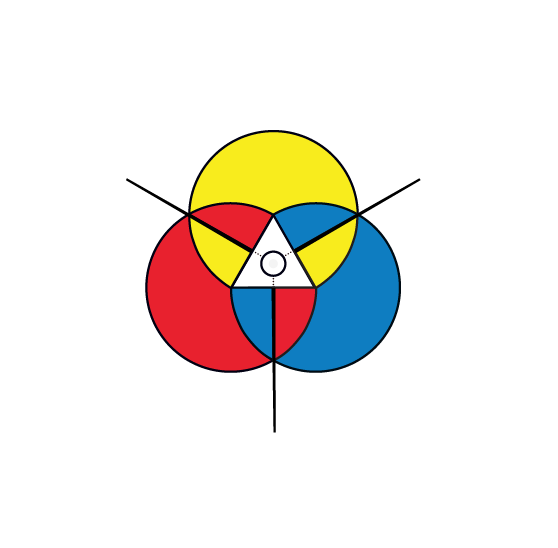
This discussion does not concern the history of either faith’s founding, but merely examines the relationship between these two religious movements, according to Minh Ly Dao’s Fire-Timing Diagram. Let us examine it from the center outward:
1. The small circle at the center of the diagram:
Please look closely at the Fire-Timing Diagram. At its very center is a circle, colored Black, belonging to Yin. Minh Ly Dao’s disciples wear black robes, taking this black circle as their emblem.
- Some may ask: surely Pure Yang alone represents the true and proper path. If it is said that Minh Ly is the True Way, why then say that Minh Ly belongs to Yin?
- The answer: outwardly, the black color represents Yin, but within, the white color represents Yang.
Considered according to the Prior-Heaven arrangement, black corresponds to Water, which belongs to Yang — meaning that within Yin there is also Yang (1 and 6).
Surrounding this black circle, on the outside, is white. When Cao Dai was first founded, its disciples wore entirely white robes, taking the white portion within the triangular shape as their emblem.
White belongs to Yang, but considered according to the Prior-Heaven arrangement, white corresponds to Metal, which belongs to Yin — meaning that within Yang there is also Yin (4 and 9).
Thus, Minh Ly is Black, while the Third Amnesty (Tam Ky) is White — the two are entirely different from one another. The Third Amnesty, belonging to Yang, tends toward activity and movement; Minh Ly, belonging to Yin, tends toward stillness and quietude.
On another point: Minh Ly was founded in the year Giap Ty (1924), preceding the Third Amnesty. Only in the year Binh Dan (1926) was the Third Amnesty founded, and at that time it borrowed the planchette (Ngoc Co) of Minh Ly Dao in order to propagate its faith. Afterward, Mr. Le Van Trung received instruction to bring offerings to the altar of Minh Ly to request scriptures. Later still, Mr. Vuong Quang Ky likewise received instruction to come to the altar of Minh Ly to learn its rites.
Having relied upon the planchette, the scriptures, and the rites of Minh Ly in order to widely propagate its faith — does this not mean that this new religion took root in Minh Ly Dao before spreading outward from there? Is it not equally true that Minh Ly Dao, in turn, benefited from having the Third Amnesty spread its teaching more widely on its behalf?
2. The triangular shape and the three large circles:
As the Third Amnesty expanded and grew ever wider, three further colors then arose — Yellow, Red, and Blue — representing the Three Teachings: Buddhism, Confucianism, and Taoism.
At its founding, the ceremonial robes of the Third Amnesty’s disciples were entirely white, corresponding to the triangular shape. Later, following the doctrine of the Three Teachings, the Third Amnesty came to distinguish three types of ceremonial robes — Yellow, Blue, and Red — corresponding to the three colors of the large circles.
- The one representing the Taoist branch wore a Blue robe, called the Thuong branch. Thus His Holiness Le Van Trung took the word Thuong as his religious surname, his own given name Trung as his middle name, and received the religious name Nhut from the Higher Powers, hence he was called Thuong Trung Nhut.
- The one representing the Confucian branch wore a Red robe, called the Ngoc branch. Thus His Holiness Le Van Lich took the word Ngoc as his religious surname, his own given name Lich as his middle name, and received the religious name Nguyet, hence he was called Ngoc Lich Nguyet.
- The one representing the Buddhist branch wore a Yellow robe, called the Thai branch — taking the word Thai as religious surname, the word Nuong as middle name, and the religious name Tinh, in the same manner as above, hence called Thai Nuong Tinh.
THUONG, NGOC, and THAI together correspond to the Three Persons of the THREE PURE ONES (Tam Thanh) of Taoism.
Though it is said that the Third Amnesty venerates the Three Teachings, in truth it venerates four — for there are, in all, four colors: first White, and afterward Blue, Red, and Yellow.
3. Three divisions:
If we examine this most carefully, we shall see: the more the three circles — Blue, Red, and Yellow — of the Third Amnesty continue to expand, the more the three black divisions of Minh Ly Dao likewise continue to lengthen and extend.
The Third Amnesty has three branches — yellow, blue, and red. Does Minh Ly not likewise have three branches? The three branches of Minh Ly are precisely these three black divisions.
What is the meaning of these three black divisions? Whoever can discover the meaning spoken of here will come to understand the true duty of Minh Ly in relation to the Way.
The colors Yellow, Blue, Red, and White are all rendered visible and distinct precisely because of these black dividing lines. In other words: these three divisions are perfectly straight, serving to render each color clearly distinguishable.
Thus, it is the duty of Minh Ly to remain fair, upright, and strictly neutral, distinguishing right from wrong, favoring neither the earlier river nor the later river, and allying with neither side against the center. We are to stand in the middle solely in order to illuminate the principle (minh ly).
At the very founding of the faith, Duc Cao Dai Himself composed the following poem, during a session convened to discuss the question of unification among the faiths:
Rejoicing in the path of virtue, what has been established here,
Though small, I urge you: do not take it lightly.
Teaching and transforming, chanting what is good, the people are steeped in righteousness,
Fellow disciples of one nature — this too is an Immortal’s verse.
This poem was given by Duc Cao Dai to Minh Ly Dao, after the disciples of Minh Ly had paid their respects at the altar of the Third Amnesty and returned home.
It may also be that these were words the Master taught to those within the Third Amnesty itself — “do not look down upon Minh Ly merely because it is small” — according to an account later related by a fellow believer of the other branch who remained there afterward.
Later still, the book Chanh Giao Thanh Truyen of the Minh Chon Ly branch explained clearly that: in this present era, the Buddha and Heaven have established Five Branches (Ngu Chi), of which Minh Ly is one. It further states:
Minh Ly is further charged with the task of transmitting the Way,
Bestowing the scriptures of repentance, exhorting all to cultivate and practice.
… … …
Because of the many currents and movements of this age,
The various branches feared it difficult to unite as one.
The Master therefore adjusted Heaven’s mechanism to found the Way,
And thus transmitted it, that the Patriarch of the Way might descend to the world.
He established the Minh Ly branch to exhort the people,
Transmitting scriptures and precepts, that Heaven’s grace might save the world.
Heaven’s mechanism had already arranged all of this within this very Fire-Timing Diagram. Whoever gives it careful thought will clearly perceive this truth.
It is not only the sacred teachings received at the altar of Minh Ly that speak of this; the sacred teachings received at the altar of the Third Amnesty likewise speak of the duty of Minh Ly. I believe that once we have examined this clearly, everyone must come to believe it, and must strive diligently to fulfill this duty in full.
4. The six small segments containing all three colors:
Let us also examine the diagram further, in its entirety.
It is precisely because of these three divisions that the diagram is divided into six segments: Comprehension, Clarity, Benevolence, Wisdom, Courage, and Strategy (already explained above).
One day, we were discussing how the Way had opened in the four directions, uncertain where it would ultimately converge and unite. At that time, Duc Thai Thuong, the Patriarch of the Way, descended through spirit-writing and posed this question:
“Consider, then, disciples: where do you suppose it shall ultimately be governed from? And what must be done in order to hold mastery over it?
[Laughing] The Way is exceedingly vast — how could it possibly satisfy every single person? I ask this because everyone here understands religious principle, understands how to spread virtue widely, yet does not know how to satisfy every person at once.
Let me ask you this: among the people of the world, many prefer their rice dry, many prefer it soft and moist, and many prefer it in between — neither too moist nor too dry. Could you, then, cook all of these different preferences within a single pot of rice?
I raise this example to illustrate the matter of establishing the Way. To satisfy everyone, and to achieve lasting stability, it is necessary to divide the work into several parts, whose results are afterward brought together as one.
If you wished to cook rice in this manner, you would need a steaming rack holding many small bowls of rice within it. For the rice that should be moist, pour in more water, then place it over the stove and cover the steamer to steam it. Once cooked, each bowl retains its own distinct texture, without mixing with the others.
When it comes time to serve the meal, each person eats the preparation they prefer, yet all the dishes and all the diners share a single table, a single sitting. Does this not satisfy the desire of each and every person?
Now, you must understand: to take on the task of gathering the various religious paths together into one place, what must be done? Follow the six words spoken of above — comprehension, clarity, benevolence, wisdom, courage, strategy — gathering the six into three, and then gathering the three into one.”
VI. CONCLUSION
Above, I have explained the Fire-Timing Diagram of Minh Ly Dao. From the center outward, every part has been explained in full, omitting no detail. Yet fellow believers must continue to reflect further upon its religious meaning, which is boundless and immeasurable, impossible to contain entirely within a single sermon.
According to my own humble understanding, I have set forth a few further points to help fellow believers broaden their understanding, yet without departing in any way from the teaching of the Higher Powers — teaching that is most essential to our practice of the faith, particularly regarding the relationship between Minh Ly and Cao Dai.
According to the theory of Yin and Yang, Yang gives birth, Yin brings to completion. The Way, therefore, must possess both Yin and Yang in full measure. If there is Yin without Yang, then nothing can be born. If there is Yang without Yin, then nothing can be brought to completion.
Minh Ly is Yin; only through the Third Amnesty, which is Yang, carrying the scriptures abroad to propagate them widely, could it be born. And the Third Amnesty, being Yang, without Minh Ly, could never have been brought to completion — for Minh Ly is the very mold in which it was forged and shaped.
In the diagram, we should also take note: “The black lines represent Minh Ly. Though the black lines are exceedingly thin and slight, few in number, they are by no means insignificant. The Third Amnesty, though vast and populous, is nevertheless entirely encompassed and held together by these black lines.“
It was stated above that the color Black corresponds to the Kidneys, belonging to Water.
Duc Thai Thuong Lao Quan once compared the Three Teachings to camphor, alcohol, and chloral. When these three chemical substances are combined together in a glass vial and shaken back and forth, they turn into water — symbolizing the union of the Three Teachings into one. This signifies that heat is required — that is, one must bring genuine fervor and sincere devotion for the task to succeed.
Regarding the Way: Camphor possesses a hot and light nature, clearing the mind and intellect, and so may be compared to the Confucian branch, which serves to open Wisdom.
Alcohol, next, purges toxins, and so may be compared to the Buddhist branch, which serves to eliminate suffering and dispel affliction.
And Chloral may be compared to the Taoist branch.
Why is this? Because it contains lime, and lime calcifies bone.
Eastern medicine holds that marrow forms bone, and bone contains lime. And from where does marrow itself arise? Marrow arises from the Kidneys, and the Kidneys govern the Prior-Heaven aspect, governing Life-Destiny (Mang).
In conclusion, Duc Thai Thuong asked: “Among these three substances, then, which one serves as the supporting pillar?“
- Response: The substance containing lime (that is, Taoism).
- Could a body without bones possibly stand upright?
- Response: No, it could not (Session of 8 September 1931).
- The Patriarch of the Way further instructed: “You disciples must strive to see that Yin transforms into Yang; but if the Third Amnesty fails to attend to this, the reverse transformation will occur instead. The Third Amnesty and Minh Ly are intimately bound together — do you disciples now see this clearly?
Within the Third Amnesty, there is a considerable number who commit wrongful deeds. You disciples must be on guard, and should not associate with such persons.“
The Patriarch of the Way instructed that a sermon be composed, gathering together all the essential meaning found within the sacred teachings cited above — particularly the session of 12 January 1935 — so as to serve as a guiding marker for fellow believers, that they might faithfully follow the intention of the Higher Powers, and act in accordance with Heaven’s design, so that Minh Ly Dao may hope to achieve a truly excellent outcome and attain the goal that has been set for it.
With utmost sincerity and faith.