
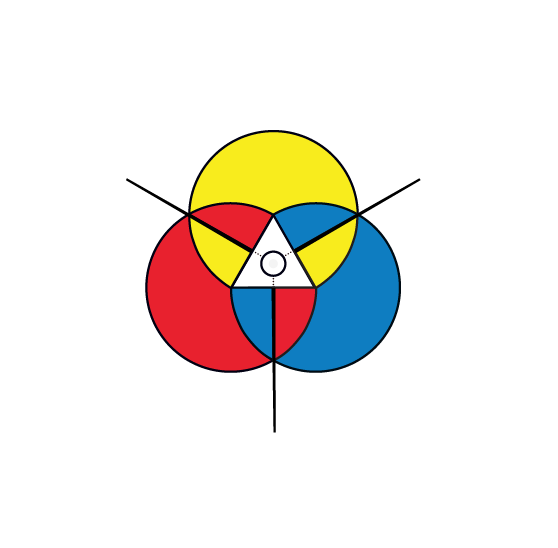

A TREATISE ON RESPONSIVE CAUSATION
By Nguyen Minh Thien, Saigon, 15th day of the first month, year Giap Tuat (28 February 1934)
Preface
The author explains that Taoist discussions of “responsive causation” (cam ung) traditionally center on the Scripture of Responsive Causation attributed to Duc Thai Thuong Lao Quan (Lao Tzu), long popularized through charitable printing throughout Vietnam, alongside related Taoist classics (the Tao Te Ching, the Nan Hua Jing of Chuang Tzu, the Chong Xu Jing of Lieh Tzu, and others) that touch on the same theme, as well as Buddhist, Confucian, and even Western Theosophical writings. Having gathered some understanding from these sources, he offers this short book in the hope it may be of some use to fellow believers, organized into four chapters: (1) the meaning of “responsive causation” in Taoism; (2) how this principle operates through good and evil, cause and consequence; (3) the same principle as understood in Buddhism and Confucianism; (4) a conclusion reconciling the Three Teachings. He hopes readers who grasp this principle will attend more carefully to their own conduct, turning from evil to good, and thereby naturally avoid calamity and enjoy lasting blessing.
Chapter One: The Meaning of “Responsive Causation” in Taoism
I. Defining the terms. “Cam” (to stir/act) corresponds to the French “action”; “ung” (to respond/react) corresponds to “réaction.” Since a reaction necessarily follows from a prior action, the term literally parallels a physical process — like a ball kicked against a wall rebounding back. Psychology offers an analogous but distinct meaning: a sensation (seeing something threatening, hearing something good) gives rise to an emotion (fear, affection) — here “cam” refers to being affected, not to acting upon something. In ordinary religious usage, people commonly (and mistakenly) equate “sincerity” with mere earnest pleading, and “stirring” the divine with ritual supplication, leading to the shallow belief that fervent prayer alone can turn misfortune into fortune, poverty into wealth — without ever examining the actual causes of one’s own circumstances or working to correct them. The author insists this is not the true meaning: the opening line of the Scripture of Responsive Causation — “Calamity and fortune have no fixed gate; it is man himself who summons them; the recompense of good and evil follows him as a shadow follows its form” — is the guiding principle of the whole text, with no reference at all to ritual petitioning for favors. Genuine belief in Heaven and the spirits is not wrong, since it amounts to belief in an impartial cosmic law of justice; what is wrong is the lazy, self-interested wish that the spirits bend that very law in one’s own favor. Heaven and the spirits may inspire and assist a sincere, upright heart engaged in real effort, but cannot be made to act on behalf of the selfish — hence “a rectified heart may meet with the spirits’ aid,” which the author takes as the true religious meaning of the term, encompassing both the visible, physical sense of action-and-reaction and the deeper moral sense together.
II. Responsive causation in relation to Heaven. Heaven, in this usage, is not a god or a person, but the singular, inexhaustible source from which all spirits, people, and things arise — called True Suchness or Dharma-nature by Buddhism, the Dao or the Void by Taoism, and Heaven or the Supreme God by Confucianism: different names for one and the same universal force pervading all space and time, such that every thought, word, and deed anywhere, at any time, resonates with it. He quotes a modern commentary on the Scripture explaining that this “Heaven” is not the visible blue sky but the formless primordial energy (khi) filling all space, with which every human breath and every rising thought — good or evil — is continuously in communication, the resulting subtle purity or turbidity of one’s breath marking, respectively, the threshold of Heaven or the gate of Hell; and this primordial energy itself serves as an automatic record of every human thought, let alone action. He further quotes the Pha Me Tong Chi of Nho Dong Lao Nhon, describing how the moral rectitude or corruption of humanity directly affects the balance of Yin and Yang and the Five Elements governing the seasons, harvests, and general well-being of the world — natural disasters and plagues being the collective consequence of accumulated human wrongdoing rather than any arbitrary cruelty on Heaven’s part — and notes a similar view in Western Theosophy, which holds that concentrated evil thought, like an accumulating magnetic force, draws further evil to itself and disrupts natural harmony, producing calamity. Yet Heaven governs the whole rather than intervening in every particular case, in keeping with the Tao Te Ching’s statement that “Heaven and Earth are not benevolent” (impartial to the totality rather than partial to any single being) — a point the author compares to Dr. Papus’s image of a ship’s captain steering the overall course without meddling in every mechanical detail or every passenger’s private affairs.
III. Responsive causation in relation to the spirits. The spirits (than minh) — Immortals, Sages, Saints — carry out Heaven’s law in guiding sentient beings along the path of evolution, each realm having its own presiding spirit (written with a lowercase “t” to distinguish from Heaven itself). Wrongdoing invites the spirits’ corrective discipline, producing suffering meant to prompt correction — which the author distinguishes carefully from any loss of free will: freedom means acting without violating this law, not license to harm others under freedom’s name; citing a Western saying, “we conquer Nature only by obeying her,” he notes that whoever submits to Heaven’s law will, as surely as two plus two makes four, find success, aided by impartial spirits who protect the good and punish the wicked without needing to be asked. He then surveys, per the Scripture of Responsive Causation, several distinct classes of spirits who record human conduct: heavenly and earthly spirits who oversee merit and fault in general (with punishments scaled to the severity of the offense); the Three Origins and Northern Dipper star-spirits, said to reside upon a person’s own head from the moment of conception, keeping an even stricter, uninterrupted record than the wandering spirits above; the Three Corpse Spirits (Tam Thi) said to dwell within the body itself, ascending to report one’s misdeeds to Heaven on Gengshen nights while one sleeps (hence the old practice of remaining awake all night on that date) — though the author stresses that merely suppressing these inner spirits through ritual without genuinely cultivating virtue accomplishes nothing, since countless other forms of oversight remain; and the Kitchen God (Tao Quan), who reports each household’s conduct monthly, illustrating why personal virtue alone is not enough if one’s own household remains disordered — genuine self-cultivation must extend to properly ordering one’s family as well.
IV. Responsive causation in relation to fellow human beings and other creatures. Beyond Heaven and the spirits, recompense also operates through ordinary human society and law: conscience and the reciprocal duties of ruler-subject, parent-child, spouse, sibling, and friend enforce moral order without external coercion, while criminal law and social institutions handle graver wrongs such as violence and theft, since individuals alone cannot always enforce justice against the strong or the organized. The Scripture itself states that “one who wrongfully kills another is as though exchanging blades to be killed in turn,” meaning that human retribution circles back on the wrongdoer eventually; the Nan Hua Jing likewise notes that open wrongdoing invites open punishment by other people, just as hidden wrongdoing invites the unseen punishment of spirits — hence the saying, “the net of man may have gaps, but the net of Heaven lets nothing slip.” Because human judgment is limited and easily clouded by desire or self-interest, this human level of recompense is necessarily imperfect and must be supplemented by the higher oversight of the spirits and of Heaven itself. This principle extends even to sentient and non-sentient creatures and natural hazards (the classical warnings against recklessly attacking a tiger bare-handed or crossing a river without a boat); but since humans, spirits, and Heaven possess successively greater wisdom and impartiality than mere brute nature, the higher levels of oversight exist precisely to correct the inevitable errors, injustices, and gaps that occur at the lower levels — as when someone drowns while nobly trying to rescue another from a river: it is Heaven and the spirits, not blind chance, that ultimately restore the balance of justice in such cases. The author closes the chapter noting that although he has separated the discussion into Heaven, spirits, and human/natural agency for clarity, in reality these three are deeply and inseparably interwoven, and cannot always be neatly distinguished in their finer workings.
(Explanatory notes in the original text define several technical terms: the Three Origins as the Heavenly, Earthly, and Water Officials; the Five Sacred Peaks as the spirits of the four cardinal directions plus the center; a “toan” as a period of one hundred days; the Three Cinnabar Fields’ six associated stars and the Northern Dipper’s nine associated stars; a “ky” as twelve years; and the Three Corpse Spirits as three specific spirits residing in the upper, middle, and lower regions of the body, under the authority of the Kitchen God, one of whom resides in every household.)
Nguyen Minh Thien
(continued in Part 2)