

ON THE FIRE-PHASES OF MINH LY DAO (CONTINUED)
V. THE RELATIONSHIP BETWEEN MINH LY DAO AND CAO DAI
Minh Ly Dao was founded in the year Giap Ty (1924) through the Mystic Mechanism and spirit-writing. Cao Dai was founded in the year Binh Dan (1926), likewise through spirit-writing.
Both newly founded religions worship the Supreme Being and the Founding Sages of the Three Teachings. Cao Dai additionally worships Jesus Christ.
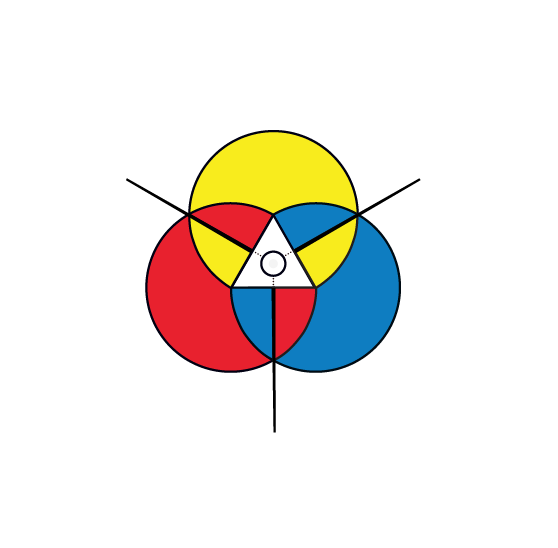
Here we shall not recount the history of these foundings, but discuss only the relationship between the two, according to the Fire-Phases Diagram of Minh Ly Dao. Let us examine it from the center outward:
1. The small circle at the center of the diagram:
Please look closely at the Fire-Phases Diagram. At its very center is a Black circle, belonging to Yin. Minh Ly disciples wear black precisely because they take this Black circle as their emblem.
- Some ask: Pure Yang alone is orthodox. If Minh Ly is said to be the Orthodox Way, why then say that Minh Ly belongs to Yin?
- Answer: Outwardly it is black, which is Yin, but within it is white, which is Yang.
According to the Prior Heaven arrangement, Black corresponds to Water, which belongs to Yang — meaning that within Yin there is also Yang (1-6).
Surrounding that black circle is the color White. Cao Dai disciples, who in the beginning wore entirely white, took the white portion within the Triangle as their emblem.
White belongs to Yang, but according to the Prior Heaven arrangement, White corresponds to Metal, which belongs to Yin — meaning that within Yang there is also Yin (4-9).
Thus Minh Ly is Black, and the Third Amnesty is White. The two are entirely different from one another. The Third Amnesty, belonging to Yang, tends toward activity; Minh Ly, belonging to Yin, tends toward stillness.
On another point, Minh Ly was founded in the year Giap Ty (1924), earlier than the Third Amnesty. Only in the year Binh Dan (1926) was the Third Amnesty founded, and it did so by borrowing the Jade Planchette of Minh Ly Dao to spread its teaching. After that, Mr. Le Van Trung was instructed to bring offerings to the Minh Ly altar to request scriptures. Later, Mr. Vuong Quang Ky was likewise instructed to come to the Minh Ly altar to learn the rites.
Since it relied on the Jade Planchette, the scriptures, and the rites of Minh Ly to spread its teaching widely, is that teaching not, in its very root, an outgrowth of Minh Ly Dao spreading outward? And is it not also true that Minh Ly Dao, in turn, owes to the Third Amnesty the wide propagation of its own teaching?
2. The triangle and the three large circles:
As the Third Amnesty expanded and spread more widely, three further colors emerged: Yellow, Red, and Blue, representing the Three Teachings of Buddhism, Confucianism, and Taoism.
In the beginning, the vestments of Third Amnesty disciples were entirely White, within the triangle. Later, following the doctrine of the Three Teachings, the Third Amnesty came to distinguish three kinds of vestments — Yellow, Blue, and Red — corresponding to the three colors of the large circle.
- The one representing the Taoist branch wears Blue and is called the Thuong (Highest) branch. Thus His Eminence Le Van Trung took Thuong as his religious surname, kept his given name Trung as a middle name, and received the religious name Nhut from the Divine Superior, and so was called Thuong Trung Nhut.
- The one representing the Confucian branch wears Red and is called the Ngoc (Jade) branch. Thus His Eminence Le Van Lich took Ngoc as his religious surname, kept his given name Lich as a middle name, and received the religious name Nguyet from the Divine Superior, and so was called Ngoc Lich Nguyet.
- The one representing the Buddhist branch wears Yellow and is called the Thai branch… taking Thai as the religious surname, Nuong as the middle name, and Tinh as the religious name, in the same manner as above, and so was called Thai Nuong Tinh.
THUONG, NGOC, and THAI are the three thrones of the Three Pure Ones (Tam Thanh) of Taoism.
Although it is said that the Third Amnesty honors the Three Teachings, in truth it honors four, for there are four colors in all: White at first, followed later by Blue, Red, and Yellow.
3. The three divisions:
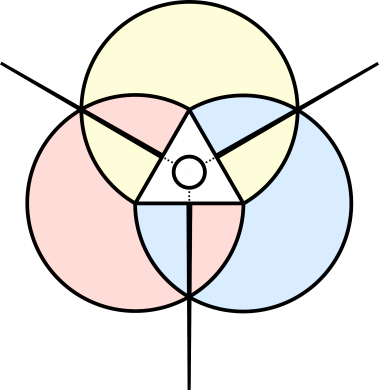
If we examine this very closely, we shall see: the more the three circles of Blue, Red, and Yellow of the Third Amnesty expand, the further the three black divisions of Minh Ly Dao extend.
The Third Amnesty has three branches — Yellow, Blue, and Red. Does Minh Ly not likewise have three branches? The three branches of Minh Ly are precisely those three black divisions.
What is the meaning of these three black divisions? Whoever discerns their meaning will understand the duty of Minh Ly toward the Way as a whole.
The colors Yellow, Blue, Red, and White are made visible and clearly distinguishable only by means of the black lines. That is: those three divisions are perfectly straight, so as to make the colors clear and distinct.
Thus it is the duty of Minh Ly to be fair, upright, and to maintain neutrality, so as to distinguish right from wrong — neither favoring the vanguard nor taking the side of the rear guard, nor forming alliances with any center of power. We stand only in the middle, to clarify what is right (minh ly).
In the early days after its founding, His Holiness Cao Dai himself gave the following verse, at a gathering held to discuss the question of unification:
Joyful on the path of virtue, a branch is founded here,
Small though it be, I bid you never scorn it.
Its teaching and its praise bathe the people in righteousness,
Fellow disciples of one nature, poetry of the Immortals still.
This verse was given by His Holiness Cao Dai to Minh Ly Dao, after the Minh Ly disciples had taken leave of the Third Amnesty altar and returned home.
It may also be that this was the Master’s instruction to those of the Third Amnesty — not to look down on Minh Ly for being small — according to the account later given by a fellow believer of the other branch who had remained behind.
Furthermore, the book Chanh Giao Thanh Truyen of the Minh Chon Ly branch explains clearly that, in this era, Buddha and Heaven established Five Branches, of which Minh Ly is one. It further says:
And Minh Ly, too, was charged to transmit the Way,
Bestowing texts of repentance, urging all to cultivate.
… … …
For there had been so many currents and movements,
That the several branches feared they could not join as one.
The Master had to adjust Heaven’s Mechanism in founding the Way,
And so had the Founding Sage of the Way descend to earth.
The Minh Ly branch was established to exhort the people,
Transmitting scripture and law, a great grace to save the world.
Heaven’s Mechanism was already laid out in advance within this Fire-Phases diagram. Whoever reflects on it carefully will see this clearly.
It is not only the Holy Teachings of the Minh Ly altar that say this; the Holy Teachings of the Third Amnesty altar likewise speak of the duty of Minh Ly. Once this has been clearly examined, everyone should surely believe it, and strive earnestly to fulfill that duty in full.
4. The six small sections containing all three colors:
Let us also examine the diagram fully to its completion.
Because of the three divisions, six sections are formed: Thong (Understanding), Minh (Clarity), Nhan (Benevolence), Tri (Wisdom), Hung (Courage), and Luoc (Strategy) (already explained earlier).
One day, we were discussing how the Way had opened out in all four directions, not knowing where it would ultimately converge. At that time, His Holiness Thai Thuong Dao To [the Grand Supreme Founding Sage] descended through the planchette and asked:
“So, disciples, consider for yourselves: to whom shall governance ultimately belong? And if one wishes to be master of it, how must one proceed?
(Laughing) The Way is vast indeed — how could it ever please everyone at once? I ask this because everyone here knows religious principle, knows how to spread virtue abroad, and yet does not know how to satisfy every single person.
Let me ask you this: among all people, many like their rice dry, many like it soft, and many like it neither too soft nor too dry, just right. Now, in a single pot of rice, could you disciples cook it in so many different ways at once?
I offer this to explain the founding of a Way. To satisfy everyone, and to endure, one must divide the work into many parts whose results are then joined together.
To cook rice in this manner, one must prepare a steamer holding many small bowls of rice within it. For the soft rice, add more water, then place it on the stove, cover the steamer, and steam it. Once cooked, each bowl keeps to its own kind, without any of them mixing together.
When it comes time to serve the meal, each person eats the kind he prefers, yet all the dishes and all the diners share the very same tray, at the very same time. Is this not a way of satisfying the wishes of everyone?
Now you must understand: to take on the task of gathering all the branches of the Way into one place, how should it be done? Follow the six words spoken above — Understanding, Clarity, Benevolence, Wisdom, Courage, and Strategy — gathering the six into three, and then gathering the three into one.”
VI. CONCLUSION
Above, I have explained the Fire-Phases Diagram of Minh Ly Dao. From center to periphery, every part has been fully explained, with nothing left out. But fellow believers must reflect further on the doctrine, which is vast and boundless, and can never be fully contained within a single lecture.
In my humble view, I offer a few further points to help fellow believers broaden their understanding, though these remain entirely within the teachings of the Divine Superiors, and are quite necessary for the practice of our religion, especially concerning the relationship between Minh Ly and Cao Dai.
According to the theory of Yin and Yang, Yang gives birth, Yin brings to completion. Thus the Way must have both Yin and Yang in full. If there is Yin without Yang, nothing can be born. If there is Yang without Yin, nothing can be completed.
Minh Ly is Yin; only through the Third Amnesty, which is Yang, carrying its scriptures abroad, could it be born into wide influence. And the Third Amnesty is Yang; without Minh Ly, it could never be completed — Minh Ly is the mold in which it is cast and formed.
In the diagram we should also note: “The black lines are Minh Ly. The black lines are very thin and slight, few in number, but they are not truly small. The Third Amnesty, though great and populous, is entirely bounded and contained by those black lines.”
It was said above that the color Black corresponds to the Kidneys, and belongs to Water.
His Holiness Thai Thuong Lao Quan compared the Three Teachings to camphor, alcohol, and chloral. When these three chemical substances are combined in a vial and shaken together, they turn into water, symbolizing the union of the Three Teachings into one. This signifies that heat is required — that is, one must be earnest and wholehearted for the work to succeed.
In terms of the Way, camphor is warm and light in nature, and clears the mind, and so is compared to the Confucian branch, which opens Wisdom.
Next, alcohol purges toxins, and so is compared to the Buddhist branch, which extinguishes suffering and eliminates afflictions.
Chloral, in turn, is compared to the Taoist branch.
Why is this? Because it contains lime, and lime forms bone.
Traditional medicine teaches that marrow forms bone, and bone contains lime. And from where does marrow arise? Marrow arises from the Kidneys, and the Kidneys govern the Prior Heaven, and one’s allotted Life-Destiny.
In conclusion, His Holiness Thai Thuong said: “Now, among these three substances, which is the main pillar?“
- Reply: The substance containing lime (that is, the Taoist branch).
- Can a body without bones stand firm?
- Reply: It cannot. (Seance of September 8, 1931.)
- The Founding Sage further instructed: “You disciples must strive to transform Yin into Yang; if the Third Amnesty does not attend to this, the reverse transformation will occur instead. The Third Amnesty and Minh Ly are bound together — do you disciples now see this clearly?
Within the Third Amnesty, a great many do wrongful things. You disciples should be on guard, and should not associate with people of that sort.”
The Founding Sage instructed that a lecture be compiled gathering together all these ideas from the Holy Teachings cited above, especially the seance of January 12, 1935, so as to serve as a guiding marker for fellow believers to follow the will of the Divine Superiors and act in accordance with Heaven’s Mechanism — only thus may Minh Ly Dao hope to achieve a fine result and attain its appointed goal.
With utmost sincerity and faith